Question
What is lateral inversion? Explain by giving a suitable example.
Answer

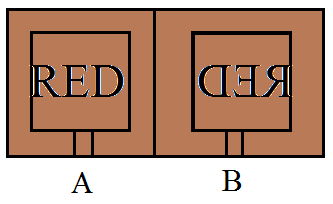
When an object is placed in front of a plane mirror, then the right side of the object appears to become the left side of the image; and the left side of the object appears to become right side of the image. This change of the sides of an object and its mirror image is called lateral inversion.
Example: When we hold a placard having the word RED written on it, as given in fig A, in the front of a plane mirror, the image of the word RED will be as given in fig B.

Need a full question paper?

Generate a complete, print-ready paper with questions like this in minutes — across 16+ boards, with answer keys.
Start Generating Free

Similar questions

Draw a neat labelled diagrams: Energy transformation in solar thermal electric energy generation.
In what respect does the construction of an A.C. generator differ from that of a D.C. generator?
Name the functional group of organic compounds that can be hydrogenated. With the help of a suitable example, explain the process of hydrogenation, mentioning the conditions of the reaction and any one change in physical property with the formation of the product. Name any one natural source of organic compounds that are hydrogenated.
What are the characteristics of an ideal fuel (or good fuel)?
What are the different methods used for removing gangue from ores?
(OR)
Write the five methods of concentration of ores.
What do you mean by haploid (n) cell?
Observe the given figure and answer the following questions. (Practice Activity Sheet – 3)
Image

(a) Identify and write the natural process shown in the figure.
(b) List the phenomena which are observed in this process.
(c) Redraw the diagram and show the above phenomena in it.

The calorific value and ignition temperature of fuel A are $55 \mathrm{~kJ} / \mathrm{g}$ and $80^{\circ} \mathrm{C}$, respectively. These values for fuel B are $80 \mathrm{~kJ} / \mathrm{g}$ and $10^{\circ} \mathrm{C}$, respectively. On burning, the fuel A produces $\mathrm{CO}_2$ and $\mathrm{H}_2 \mathrm{O}$ while the fuel B produces $\mathrm{CO}_2, \mathrm{CO}$ and $\mathrm{SO}_2$. Give three points of relative and disadvantages of these two fuels.
Name three products of the chlor-alkali process. State two uses of each of these products.
What are the constituents of acid rain? What are its two effects on earth's surface ?