Question
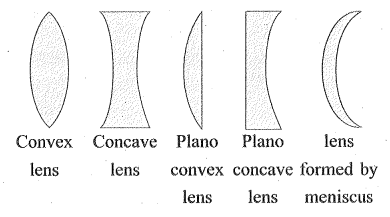
What is lens? State their types and draw their diagram.

Answer

→A structure formed by two refracting surfaces and capable of forming an image is called a lens.
→Types of lenses :
(1) Convex lens
(2) Concave lens
(3) Plano convex lens
(4) Plano concave lens
(5) lens formed by meniscus
Image

Need a full question paper?

Generate a complete, print-ready paper with questions like this in minutes — across 16+ boards, with answer keys.
Start Generating Free

Similar questions

Explain $($or write a short note on$)$ capacitors and capacitance.
Define the distance of closest approach.
  1. Distinguish between ‘Analog’ and ‘Digital’ forms of communication.
  2. Explain briefly two commonly used applications of the ‘Internet’.
Derive an expression for the resistivity of a good conductor, in terms of the relaxation time of electrons.
What is stationary interference? How can we get, the resultant intensity of super position of waves emanated from the incoherent sources?
Assume that the magnetic field is uniform in a cubical region and is zero outside. Can you project a charged particle from outside into the field so that the particle describes a complete circle in the field?
A block of massip, sliding on a smooth horizontal surface with a velocity $\vec{\text{v}}$ meets a long horizontal spring fixed at one end and having spring constant k as shown in figure. Find the maximum compression of tin spring. Will the velocity of the block be the same $\vec{\text{v}}$ when it comes back to the original position shown?
A cylindrical capacitor is constructed using two coaxial cylinders of the same length 10cm and of radii 2mm and 4mm:
  1. Calculate the capacitance.
  2. Another capacitor of the same length is constructed with cylinders of radii 4mm and 8mm. Calculate the capacitance.
The current in a discharging LR circuit is given by $\text{i}=\text{i}_0\text{e}^{\frac{-\text{t}}{\tau}}$ where $\tau$ is the time constant of the circuit. Calculate the rms current for the period $\text{t}=0$ to $\text{t}=\tau.$
A parallel beam of monochromatic light is used in a Young's double slit experiment. The slits are separated by a distance d and the screen is placed parallel to the plane of the slits. Show that if the incident beam makes an angle $\theta=\sin^{-1}\Big(\frac{\lambda}{2\text{D}}\Big)$ with the normal to the plane of the slits, there will be a dark fringe at the centre $P_0$ of the pattern.