Question
What is lymphatic system? What are its functions?

Answer

Lymphatic system: A system of tiny tubes called lymph vessels (lymphatics) and lymph nodes (lymph glands) in the human body which transports the liquid called lymph from the body tissues to the blood circulatory system is called lymphatic system. Functions of lymphatic system:
  1. It takes part in the nutritive process of the body.
  2. It protects the body by killing the germs drained out of the body tissues with the help of lymphocytes contained in the lymph nodes, by making antibodies.
  3. It helps in removing the waste products like fragments of dead cells etc.

Need a full question paper?

Generate a complete, print-ready paper with questions like this in minutes — across 16+ boards, with answer keys.
Start Generating Free

Similar questions

Explain the factors affecting the value of $g.$
Which type/types of power generation involve maximum number of steps of energy conversion? In which power generation is the number minimum?
When a mixture of gases $X$ and $Y$ is compressed to $300$atm pressure and then passed over a catalyst consisting of a mixture of zinc oxide and chromium oxide $($heated to a temperature of $300^\circ C),$ then an organic compounds $Z$ having the molecular formula $CH_4O$ is formed. $X$ is a highly poisonous gas which is formed in appreciable amounts when a fuel burns in a limited supply of air; $Y$ is a gas which can be made by the action of a dilute acid on an active metal; and $Z$ is a liquid organic compound which can react with sodium metal to produce hydrogen gas:
  1. What are $X, Y$ and $Z?$
  2. Write a balanced chemical equation of the reaction which takes place when $X$ and $Y$ combine to form $Z.$ Indicate the conditions under which the reaction occurs.
The human body has an organ A which acts as a double pump. The oxygenated blood coming from the lungs through a blood vessel B enters the upper left chamber C of the double pump. When chamber C contracts, then blood goes into lower left chamber D. The contraction of chamber D forces the blood to go into a blood vessel E which supplies oxygenated blood to all the organs of the body (except the lungs). The deoxygenated blood coming out of the body organs is taken by a blood vessel F to the right upper chamber G of pumping organ. Contraction of chamber G forces the deoxygenated blood into right lower chamber H. And finally the contraction of chamber H sends the deoxygenated blood into lungs through a blood vessel I.
  1. What is organ A?
  2. Name the blood vessel (i) B (ii) E (iii) F, and (iv) I.
  3. What are chambers (i) C, and (ii) D?
  4. What are chambers (i) G and (ii) H?
What is meant by the apparent size of an object? With a neat and labelled diagram, explain the relation between the apparent size of an object and the angle subtended by the object at the eye.
Complete the chart as per the objectives of first aid.
What is meant by the orbit of a satellite? On what basis and how are the orbits of artificial satellites classified?
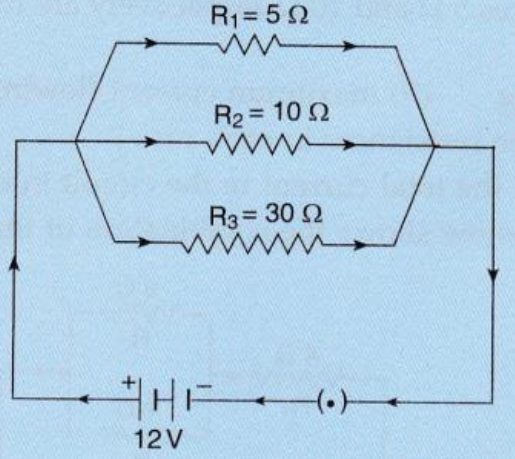
In the circuit diagram given below, three resistors R R , and R of $5 Ω, 10 Ω$ and $30 Ω,$ respectively are connected as shown.
Calculate:
  1. Current through each resistor.
  2. Total current in the circuit.
  3. Total resistance in the circuit.
Write a short note.
Regelation
What is meant by ‘reflection of light’? Define the following terms used in the study of reflection of light by drawing a labelled ray-diagram :
  1. Incident ray.
  2. Point of incidence.
  3. Normal.
  4. Reflected ray.
  5. Angle of incidence.
  6. Angle of reflection.