Question
What is matching concept? Why should a business concern follow this concept? Discuss.

Answer

Matching Concept states that all expenses incurred during the year, whether paid or not, and all revenues earned during the year, whether received or not, should be taken into account while determining the profit of that year. For Example: When some expense such as insurance premium is paid partly for the next year also, the part relating to next year will be shown as expense only next year not this year.
This concept is very important for correct determination of net profit. It is possible that in the same accounting period, the business may either pay or receive payments that may or may not belong to the same accounting period.
This leads to either overcasting or under-casting of the profit or loss, which may not reveal the true efficiency of the business and its activities in the concerned accounting period. Similarly, there may be various expenditures like, purchase of machinery, buildings, etc.
These expenditures are capital in nature and their benefits can be availed over a period of time. In such cases, only the depreciation of such assets is treated as an expense and should be taken into account for calculating profit or loss of the concerned year. Thus, it is very necessary for any business entity to follow the matching concept.

Need a full question paper?

Generate a complete, print-ready paper with questions like this in minutes — across 16+ boards, with answer keys.

Start Generating Free

Similar questions

Prepare Sales book and Purchases book of M/s Deendayal from the following transactions.
2016
 
June 7
Purchased from Arora & Co., Nai Sarak
10 Chairs @ ₹ 200 each
1 Table for ₹ 600
Trade discount 10%
June 10
Sold to Sudha Furniture Co., Agra
2 Almirahs @ ₹ 2,000 each
Less: 15%
June 12
Sold to Meera Mart for cash
10 Tables @ ₹ 1,000 each
June 15
Purchased from Hira Lal & Sons for cash
15 Chairs @ ₹ 350 each
June 16
Purchased from Fateh Chand & Co., Delhi
5 Chairs @ ₹ 180 each
June 25
Sold to Ravi Sharma, Delhi
2 Dining Tables @ ₹ 6,000 each
Less: 10%
 
What is a suspense account? When is it opened?
Show the effect of the following transactions and also prepare a Balance Sheet:
  1. Started business with cash ₹ 60,000.
  2. Rent received ₹ 2,000.
  3. Accrued interest ₹ 500.
  4. Commission received in advance ₹ 1,000.
  5. Amount withdrawn ₹ 5,000.
[Hint: Capital = Opening Capital ₹ 60,000 + Rent Received ₹ 2,000 + Accrued Interest ₹ 500 - Drawings ₹ 5,000 = ₹ 57,500.]
X bought a machine for ₹ 25,000 on which he spent ₹ 5,000 for carriage and freight. ₹ 1,000 for brokerage of the middleman, ₹ 3,500 for installation and ₹ 500 for an iron pad. The machine is depreciated @ 10% p.a. on Written Down Value basis. After three years, the machine was sold to Y for ₹ 30,500 and ₹ 500 was paid as commission to the broker through whom the sale was effected. Find out the profit and loss on sale of machine.
Give any three points of distinction between cash basis and accrual basis of accounting.
From the following information supplied by Sanjay, prepare his Bank Reconciliation Statement as on 31st March, 2019:
   
(i) Bank overdraft as per Pass Book. 16,500
(ii) Cheques issued but not presented for payment. 8,750
(iii) Cheques deposited with the Bank but not collected. 10,500
(iv) Cheques recorded in the Cash Book but not sent to the bank for collection. 2,000
(v) Payments received from customers directly by the bank. 3,500
(vi) Bank charges debited in the Pass Book. 200
(vii) Premium on life policy of Sanjay paid by the bank on standing advice. 1,980
(viii) A bill for ₹ 3,000 (discounted with the bank in February) dishonoured on 31st March, 2019 and noting charges paid by the bank. 100
From the following information, prepare Bank Reconciliation Statement as on 31st March, 2019:
 
 
(i)
Bank overdraft as per Pass Book.
36,000
(ii)
Cheques issued but not presented for payment.
19,700
(iii)
Cheques deposited with bank but not collected.
25,000
(iv)
Cheques entered in Cash Book but not banked.
9,000
(v)
Directly deposited to bank by a customer.
11,000
Pass entries in the books of Mr. Roopani of Gujarat assuming CGST @ 9% and SGST@ 9%.
1.
Purchased goods for ₹ 2,00,000 from Suryakant of Jaipur (Rajasthan) on Credit.
2.
Sold goods for ₹ 1,50,000 to Mr. Pawar of Mumbai (Maharashtra) and the cheque received was sent to bank.
3.
Sold goods for ₹ 2,50,000 within the state on credit.
4.
Paid insurance premium of 20,000 by cheque.
5.
Purchased furniture for office for ₹ 60,000 by cheque.
6.
Payment made of balance amount of GST.
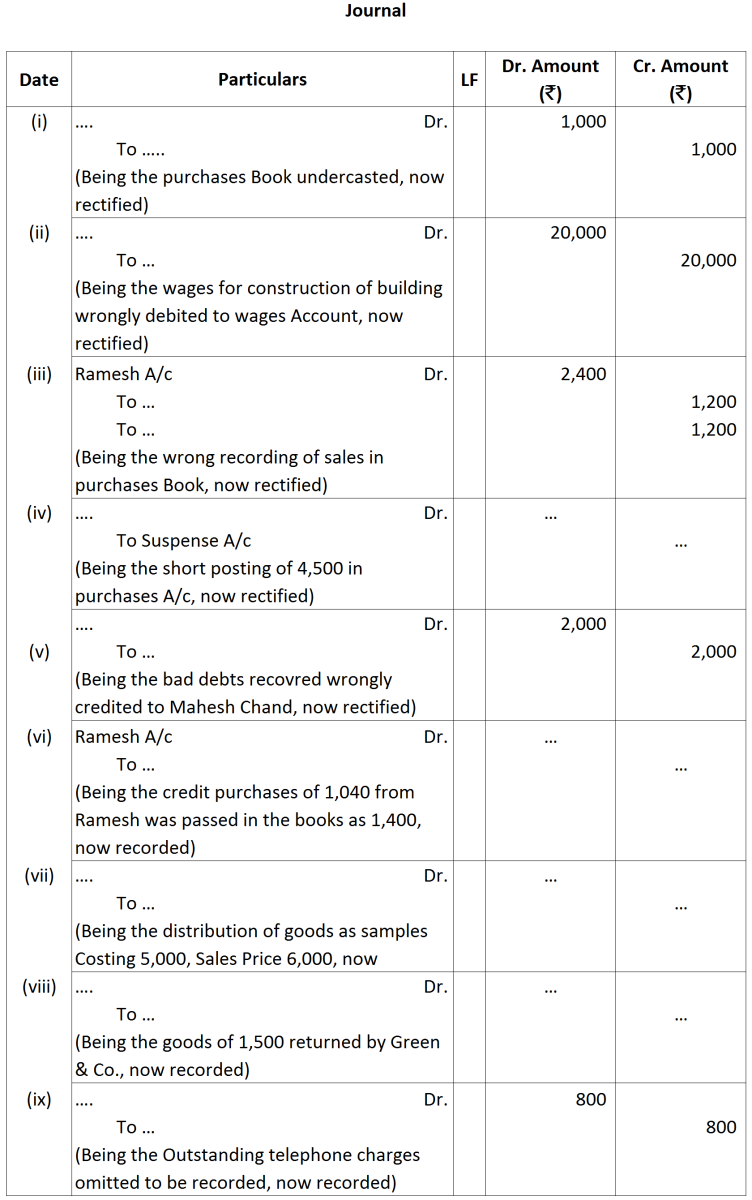
Determine the missing information in the following Rectifying Journal Entries:
Show the accounting equation on the basis of following transactions:
  1. Commenced business with Cash ₹ 20,000; Goods ₹ 50,000 and Furniture ₹ 30,000.
  2. Purchased goods from Gopal on Credit ₹ 40,000.
  3. Sold goods for Cash ₹ 40,000 (costing ₹ 30,000).
  4. Sold goods to Ram on Credit ₹ 65,000 (costing ₹ 50,000).
  5. Withdrew for personal use goods costing ₹ 5,000.
  6. Purchased typewriter for personal use of the proprietor ₹ 20,000.
  7. Purchased chairs for office use for Cash ₹ 10,000.
  8. Paid for printing ₹ 500 and received Commission ₹ 1,200.
  9. Introduced fresh Capital ₹ 40,000.
  10. Paid to Gopal ₹ 30,000.