Question
What is meant by emasculation? When and why does a plant breeder employ this technique?

Answer

Emasculation means removal of anthers, with a forceps, from the flower bud before dehiscence.
Plant breeder employs this technique to prevent contamination of stigma with the undesired pollen. This is useful in artificial hybridisation, where desired pollen is required.

Need a full question paper?

Generate a complete, print-ready paper with questions like this in minutes — across 16+ boards, with answer keys.

Start Generating Free

Similar questions

Answer the following questions:
Give two reasons why Mendel selected garden pea for his experiments. Give the biological name of this plant.
Answer the following questions:
Name two intrauterine contraceptive devices that affect the motility of sperms.
Explain productivity about sustainable ecosystem.Describe productivity as a unit of ecosystem.
Can you think and answer how a reporter enzyme can be used to monitor transformation of host cells by foreign DNA in addition to a selectable marker?
Write any four main features of the structure of double helical DNA.
What are transgenic plants? Give some example.
Somatic chromosome number is 40. What shall be the chromosome number in the cells of seminiferous tubules?
Recombinant DNA technology is of great importance in the field of medicine. With the help of a flow chart, show how this techonolgy has been used in preparing genetically engineered human insulins.
The following illustrates the linking of DNA fragments A DNA fragments:
  1. Write the name of A and B.
  2. Complete the palindrome, which is recognized by EcoRI.
  3. Write the name of the enzyme that can link the two DNA fragments.

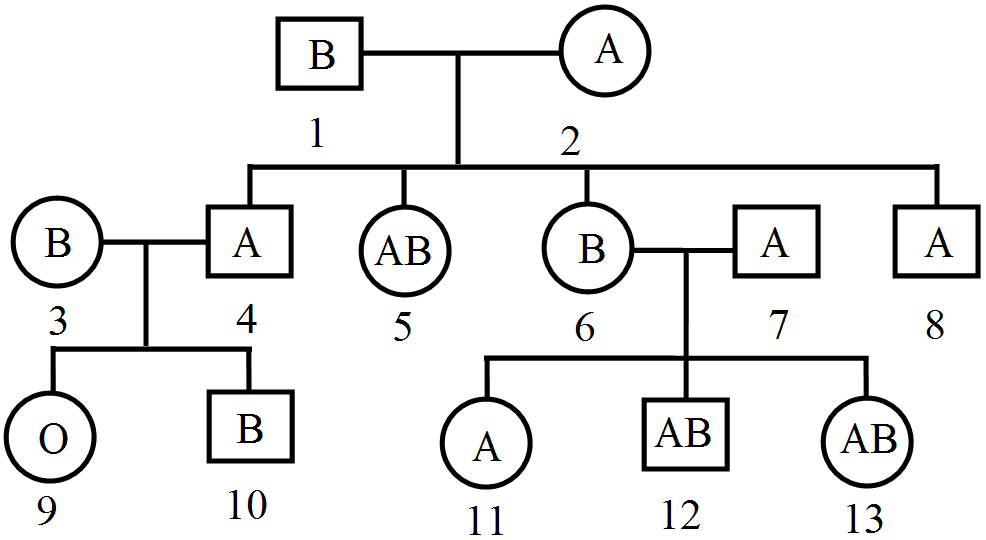
Study the pedigree chart given above, showing the inheritance pattern of blood groups in a family and answer the following questions:
  1. Give the possible genotypes of the individuals 1 and 2.
  2. Which antigen or antigens will be present on the plasma membranes of the RBCs of individuals 5 and 9?
  3. Give the genotypes of the individuals 3 and 4.