Question
What is meant by nuclear mass defect?

Answer

Nuclear Mass Defect :
The difference between the total mass of protons and neutrons present in the nucleus and the actual mass of the nucleus is called mass defect.
Mass defect $=$ Mass of the nucleus obtained by
calculation $-$ Actual mass of the nucleus
$\Delta m=m_c-m_a$
Here, the calculated mass is abbreviated as $m _{c}$ and the actual mass is shown as $m_a$.
Therefore, $ \Delta m=[$ Mass of protons $+$ Mass of neutrons$] -$ Actual mass of nucleus
or $\quad$
$\Delta m=\left[ Z \cdot m_p+(A-Z) m_n\right]-m$
where$, Z$ is the atomic number of the atom$, A$ is the mass number, $m_p$ is the mass of the proton, $m_n$ is the mass of the neutron and $m$ is the actual mass of the nucleus.

Need a full question paper?

Generate a complete, print-ready paper with questions like this in minutes — across 16+ boards, with answer keys.
Start Generating Free

Similar questions

Write the product of equivalent capacitances when 10 capacitors, each having a capacitance of $10 \mu F$, are connected in series and then parallel connection.
The temperature and relative humidity in a room are $300K$ and $20\%$ respectively. The volume of the room is $50m^3$. The saturation vapour pressure at $300K$ is $3.3\ kPa$. Calculate the mass of the water vapour present in the room.
The sunlight reaching Earth has maximum electric field of $810\ Vm^{-1}.$ What is the maximum magnetic field in this light?
An illuminated object and a screen are placed 90 cm apart. Determine the focal length and nature of the lens required to produce a clear image on the screen, twice the size of the object.
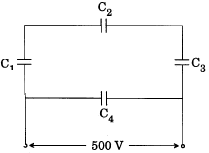
A network of four capacitors each of $12 \mu F$ capacitance is connected to a $500 V$ supply as shown in the figure. Determine $(a)$ equivalent capacitance of the network and $(b)$ charge on each capacitor.
In a chamber, a uniform magnetic field of $6.5 G (1 G = 10^{–4} T)$ is maintained. An electron is shot into the field with a speed of $4.8 \times 10^6\ m s^{–1}$ normal to the field. Explain why the path of the electron is a circle. Determine the radius of the circular orbit.
$(e = 1.6 \times 10^{–19} C, m_e = 9.1\times 10^{–31} \ kg)$
A solenoid of length $1.0m,$ radius $1\ cm$ and total turns $1000$ wound on it, carries a current of $5A$. Calculate the magnitude of the axial magnetic field inside the solenoid. If an electron was to move with a speed of $104ms^{–1}$ along the axis of this current carrying solenoid, what would be the force experienced by this electron?
Two concentric circular coils, one of small radius $r_1$ and the other of large radius $r_2$, such that $r_1 \ll r_2$, are placed co-axially with centres coinciding. Obtain the mutual inductance of the arrangement.
The temperature and the relative humidity are $300K$ and $ 20\%$ in a room of volume $50m^3.$ The floor is washed with water, $500g$ of water sticking on the floor. Assuming no communication with the surrounding, find the relative humidity when the floor dries. The changes in temperature and pressure may be neglected. Saturation vapour pressure at $300K = 3.3kPa.$
The time taken by Mars to revolve round the sun is 1.88 years. Find the ratio of average distance between Mars and the sun to that between the earth and the sun.