Question
What is meant by oxidation and reduction reactions? Explain it by giving examples.

Answer

  • Chemical reaction in which a substance (atom or molecule) gains oxygen or losses hydrogen is called an oxidation reaction.
  • For example,
  • $\mathrm{C}+\mathrm{O}_2 \rightarrow \mathrm{CO}_2$
  • $2 \mathrm{Mg}+\mathrm{O}_2 \rightarrow 2 \mathrm{Mgo}$
  • $2 \mathrm{Cu}+\mathrm{O}_2 \rightarrow 2 \mathrm{Cuo}$
  • In above reactions, $C, Mg$ and $Cu$ gain oxygen, and undergo oxidation reactions.
  • Chemical reaction in which a substance (atom or molecule) loses oxygen or gains hydrogen is called reduction reaction.
  • For example :
  • $\mathrm{CuO}+\mathrm{H}_2 \rightarrow \mathrm{Cu}+\mathrm{H}_2 \mathrm{O}$
  • $\mathrm{CO}_2+\mathrm{H}_2 \rightarrow \mathrm{CO}+\mathrm{H}_2 \mathrm{O}$
  • $\mathrm{MgO}+\mathrm{H}_2 \rightarrow \mathrm{Mg}+\mathrm{H}_2 \mathrm{O}$
  • In above reactions, $\mathrm{CuO}, \mathrm{CO}_2$ and $MgO$ lose oxygen. Hence, these are reduction reactions.

Need a full question paper?

Generate a complete, print-ready paper with questions like this in minutes — across 16+ boards, with answer keys.
Start Generating Free

Similar questions

A current of 1 A flows in a series circuit containing an electric lamp and a conductor of $5 \Omega$ connected to a 10 V battery. Calculate the resistance of the electric lamp.
Now if a resistance $10 \Omega$ is connected in parallel with this series combination, what change (if any) in current flowing through $5 \Omega$ conductor and potential difference across the lamp will take place? Give the reason.
A copper wire has diameter 0.5 mm and resistivity of $1.6 \times 10^{-8} \Omega m$. What will be the length of this wire to make its resistance $10 \Omega$ ? How much does the resistance change if the diameter is doubled?
Describe the structure and functioning of nephrons.
Explain the tetravalency of carbon.
Explain the excretory system of human being.
Difference between: Binary fission and Multiple fission
Discuss the formation of Ozone layer.
Differentiate between short-circuiting and overloading.
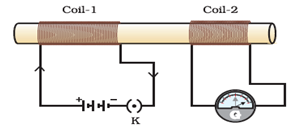
Two coils of insulated copper wire are wound over a non-conducting cylinder as shown in figure $13.28$. Coil $1$ has larger number of turns.


$(1)$ Write your observations when, $A$. plug key $K$ is closed and $B$. plug key $K$ is opened. $(2)$ Give reason for your observations. $(3)$ Mention the name of the phenomenon involved and define it. $(4)$ Write the names of two coils used in this experiment. OR What are these coils called?
Explain the formation of hydrogen molecule $\text {H}_2$ by covalent bond.###Explain the formation of covalent bond in hydrogen molecule $\text {H}_2.$