Question
What is meant by polarization of light?

Answer

This phenomenon related to light in which the vibrations of the electric vector of light are limited to one direction rather than in all possible directions in the plane perpendicular to the direction of wave propagation, is called polarization of light and light polarized light.

Need a full question paper?

Generate a complete, print-ready paper with questions like this in minutes — across 16+ boards, with answer keys.
Start Generating Free

Similar questions

An $\alpha$–particle and a proton are moving in the plane of paper in a region where there is a uniform magnetic field directed normal to the plane of the paper. If the particles have equal linear momenta, what would be the ratio of the radii of their trajectories in the field?
Distinguish between 'intrinsic' and 'extrinsic' semiconductors.
Electric charge is distributed in a small volume. The electric flux passing through a total charge enclosed by a spherical surface of radius 10 cm is 10 Vm . Then what will be the flux associated with a concentric sphere of radius 20 cm ?
The current in the forward bias is known to be more $(\sim\mu\text{A})$ than the current in the reverse bias $(\sim\mu\text{A})$.What is the reason, then, to operate the photodiode in reverse bias?
The earth revolves round the sun because the sun attracts the earth. The sun also attracts the moon and this force is 'about twice as large as the attraction of the earth on the moon. Why does the moon not revolve round the sun? Or does it?
State the concept of mobile telephony and explain its working.
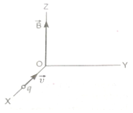
As shown in figure, a charge q moving along the X -axis with a velocity $\vec{v}$ is subjected to a uniform magnetic field $\vec{B}$ acting along the Z-axis as it crosses the origin O.
Image
i. Trace its trajectory.
ii. Does the charge gain kinetic energy, as it enters the magnetic field? Justify your answer.
Why do semiconductors obey Ohm's law for only low fields?
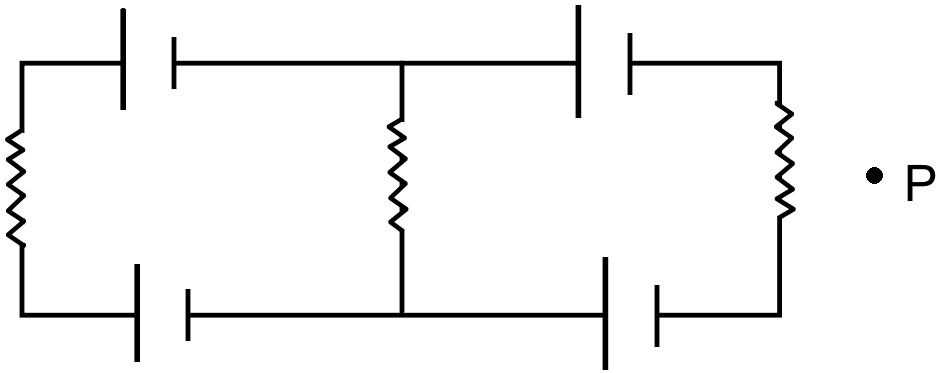
Each of the batteries shown in figure has an emf equal to 5V. Show that the magnetic field B at the point P is zero for any set of values of the resistances.
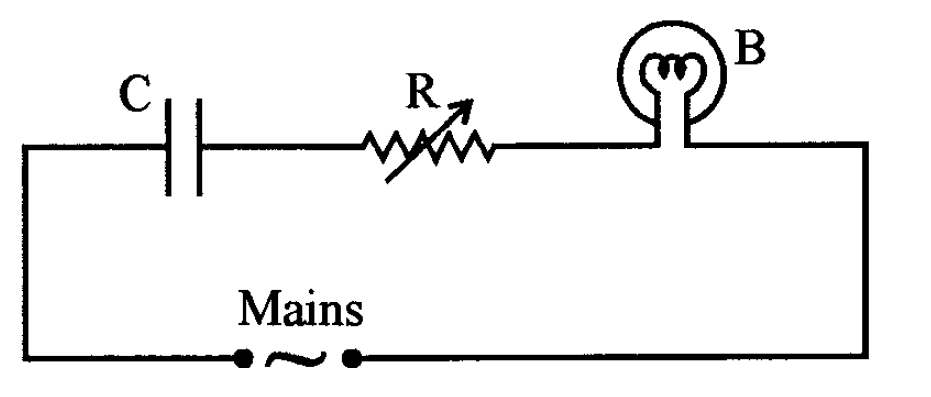
A capacitor'C', a variable resistor 'R' and a bulb oB' are connected in series to the ac mains in circuit as shown. The bulb glows with some brightness. How will the glow of the bulb change if (i) a dielectric slab is introduced between the plates of the capacitor, keeping resistance R to be the same; (ii) the resistance R is increased keeping the same capacitance?