Question
What is natural frequency of a system ? What is resonance? - Explain using a simple example.
###
What is resonance ? Explain using an appropriate example.

Answer

→Natural Frequency : "When a system capable of oscillating is given some initial displacement from its equilibrium position and left free, it begins to oscillate. Thus the oscillations performed by the system in the absence of any type of resistive forces are known as natural (free) oscillations."
If such a system is driven by an energy source at a frequency that is near the natural frequency, the amplitude of the oscillations is found to be large. This phenomenon is known as resonance.
→Example : A familiar example of this phenomenon is a child on a swing. The swing has a natural frequency for swinging back and forth like a pendulum. If the child pulls on the rope at regular intervals and the frequency of the pulls is almost the same as frequency of swinging, the amplitude of the swinging will be large.
Need a full question paper?

Generate a complete, print-ready paper with questions like this in minutes — across 16+ boards, with answer keys.

Start Generating Free

Similar questions

  1. An em wave is travelling in a medium with a velocity $\overrightarrow{\text{v}} = \text{v}\hat{\text{i}}.$ Draw a sketch showing the propagation of the em wave, indicating the direction of the oscillating electric and magnetic fields.
  2. How are the magnitudes of the electric and magnetic fields related to the velocity of the em wave?
Find the condition under which the charged particles moving with different speeds in the presence of electric and magnetic field vectors can be used to select charged particles of a particular speed.
Depict the field-line pattern due to a current-carrying solenoid of finite length.
i. In what way do these lines differ from those due to an electric dipole?
ii. Why can't two magnetic field lines intersect each other?
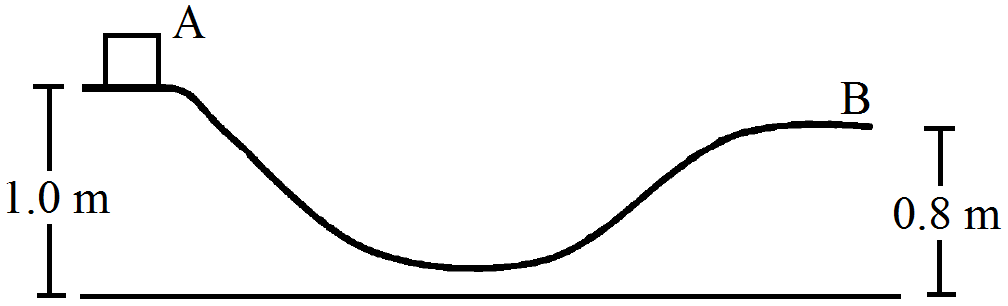
A block of mass $1\ kg$ is placed at the point $A$ of a rough track shown in figure. If slightly pushed towards right, it stops at the point $B$ of the track. Calculate the work done by the frictional force on the block during its transit from $A$ to $B.$
The changes in a function y and the independent dy variable x are related as $\frac{\text{dy}}{\text{dx}}=\text{x}^2.$ Find y as a function of x.
What is refraction of light? Explain law of refraction.
A cell of emf $E$ and internal resistance r is connected to two external resistances $R_1$ and $R_2$ and a perfect ammeter.The current in the circuit is measured in four different situations:
  1. Without any external resistance in the circuit.
  2. With resistance $R_1$ only.
  3. With $R_1$ and $R_2$ in series combination.
  4. With $R_1$ and $R_2$ in parallel combination.
The currents measured in the four cases are $0.42 A, 1.05 A, 1.4 A$ and $4.2 A$, but not necessarily in that order. Identify the currents corresponding to the four cases mentioned above.
Write the formula for the torque acting on a current$-$carrying coil placed in uniform magnetic field and explain its stable and unstable equilibrium states.
It is said that the separation between the two charges forming an electric dipole should be small. Small compared to what?
Explain the lateral shift for a ray refracted from a glass slab with parallel sides.