Question
What is nucleophilic substitution reaction ? Write down different products obtained from alkyl halides.

Answer

$\rightarrow$ Nucleophiles are electron rich species.
Therefore, they attack at that part of the substrate molecule which is electron deficient.
$\rightarrow $ The reaction in which a nucleophile replaces already existing nucleophile in a molecule is called nucleophilic substitution reaction.
$\rightarrow$ Haloalkanes are substrate in these reactions.
Image
$\rightarrow$ In this type of reaction, a nucleophile reacts with haloalkane $($the substrate$)$ having a partial positive charge on the carbon atom bonded to halogen.
$\rightarrow$ A substitution reaction takes place and halogen atom, called leaving group departs as halide ion.
Since the substitution reaction is initiated by a nucleophile, it is called nucleophilic substitution reaction.
$\rightarrow$ It is one of the most useful classes of organic reactions of alkyl halides in which halogen is bonded to $SP^3$ hybridised carbon.
$\ce{R - X + Nu ^{-} \rightarrow R - Nu + X ^{-}}$​​​​​​​
Reagent Nucleophile
$(Nu^-)$
Substitution
product
$R-Nu$
Class of main
product
$NaOH (KOH)$ $HO^-$ $ROH$ Alcohol
$H₂O$ $H₂O$ $ROH$ Alcohol
$NaOR'$ $R'O^-$ $ROR'$ Ether
$Nal$ $Γ$ $R-I$ Alkyl iodide
$NH_3$ $NH_3$ $RNH_2$ Primary amine
$R'NH₂$ $R'NH_2$ $RNHR'$ Sec. amine
$R'R"NH$ $R'R"NH$ $RNR'R"$ Tert. amine
$KCN$ $\overline{ C } \equiv N :$ $RCN$ Nitrile $($cyanide$)$
$AgCN$ $Ag-CN$ $RNC$ Isonitrile $($isocyanide$)$
$KNO_2$ $O = N - O$ $R-O-N=O$ Alkyl nitrite
$AgNO_2$ $Ag -\ddot{ O }- N = O$ $R-NO_2$ Nitroalkane
$R'COOAg$ $R'COO^-$ $R'COOR$ Ester
$LiAlH _4$ $H$ $RH$ Hydrocarbon
$R'^-M^+$ $R'$ $RR'$ Alkane

Need a full question paper?

Generate a complete, print-ready paper with questions like this in minutes — across 16+ boards, with answer keys.
Start Generating Free

Similar questions

Vapour pressure of water at $20^oC$ is $17.5 \ mm \ Hg.$ Calculate the vapour pressure of water at $20^oC$ when $15 g$ of glucose $($Molar mass $=180 g \ mol^{-1})$ is dissolved in $150 g$ of water.
A $0.1539$ molal aqueous solution of cane sugar $($mol. mass $= 342 g\ mol^{-1})$ has a freezing point of $271\ K$ while the freezing point of pure water is $273.15 K$. What will be the freezing point of an aqueous solution containing $5 g$ of glucose $($mol. mass $= 180 g\ mol^{-1})$ per $100 g$ of solution?
Write note on Hydrogen Oxygen fuel cell.
Give the principle of the manufacture of nitric acid from ammonia?
Explain types of Electrodes with examples
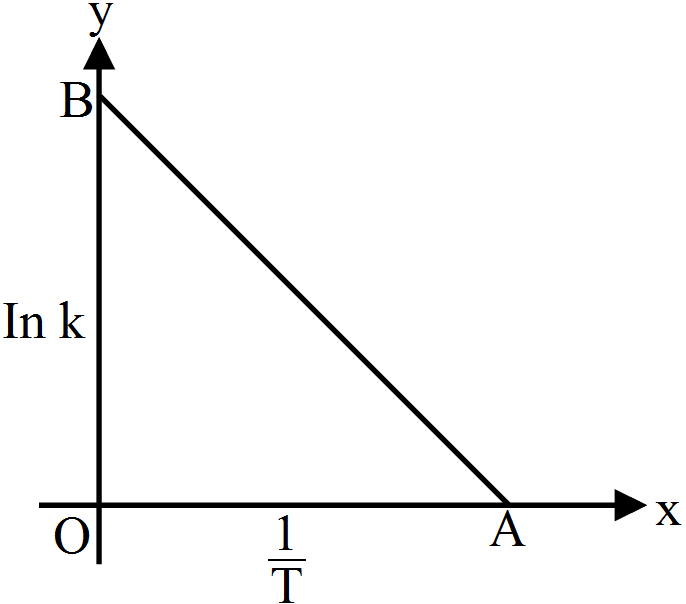
A graph between ln $k$ and $\frac{1}{\text{t}}$ for a reaction is given. Here $k$ is rate constant and $T$ is temperature in Kelvin.If $OA = a$ and $OB = b,$ answer the following:
  1. What is the activation energy $(Ea)$ of the reaction?
  2. What is the frequency factor $(A)$ for the reaction?
Discuss the nature of bonding in metal carbonyls.
earrange the compounds of each of the following sets in order of reactivity towards $S_N2$ displacement:
  1. $2-$Bromo$-2-$methylbutane, $1-$Bromopentane, $2-$Bromopentane.
  2. $1-$Bromo$-3-$methylbutane, $2-$Bromo$-2-$methylbutane, $3-$Bromo$-2-$methylbutane.
  3. $1-$Bromobutane, $1-$Bromo$-2, 2-$dimethylpropane, $1-$Bromo$-2-$methylbutane.
Among the isomeric alkanes of molecular formula $\ce{C_5H_{12}},$ identify the one that on photochemical chlorination yields,
  1. A single monochloride.
  2. Three isomeric monochlorides.
  3. Four isomeric monochlorides.
Write down the number of $3d$ electrons in each of the following ions: $\ce{Ti^{2+}, V^{2+}, Cr^{3+}, Mn^{2+}, Fe^{2+}, Fe^{3+}, Co^{2+}, Ni^{2+}}$ and $\ce{Cu^{2+}}.$ Indicate how would you expect the five $3d$ orbitals to be occupied for these hydrated ions $($octahedral$).$