Question
What is nucleus? Give a general introduction.

Answer

The central part of an atom is called nucleus. The nucleus contains the positive charge of the atom and mass densely concentrated at the centre of the atom.
The dimensions of a nucleus are much smaller than those of an atom.
Rutherford's experiments on scattering of $\alpha$ particles demonstrated that the radius of a nucleus was smaller than the radius of an atom by a factor of about $10^4$.
From this we can say that the volume of a nucleus is about $10^{-12}$ times the volume of the atom.
In other words the atom is almost empty.
If an atom is enlarged to the size of a classroom, the nucleus would be of the size of pinhead.
The nucleus contains most (more than $99.9 \%$ ) of the mass of an atom.

Need a full question paper?

Generate a complete, print-ready paper with questions like this in minutes — across 16+ boards, with answer keys.
Start Generating Free

Similar questions

An electric field $\vec{\text{E}}=\vec{\text{i}}\text{Ax}$ exists in the space, where $A= 10Vm^{-2}.$ Take the potential at $(10m, 20m)$ to be zero. Find the potential at the origin.
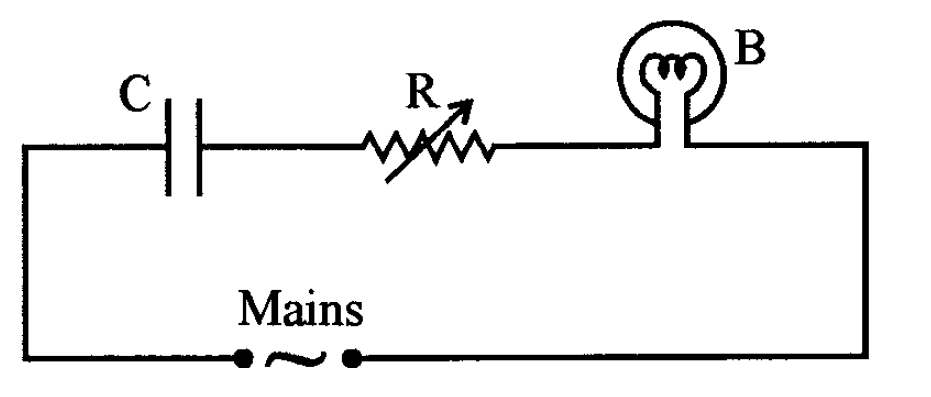
A capacitor'C', a variable resistor 'R' and a bulb oB' are connected in series to the ac mains in circuit as shown. The bulb glows with some brightness. How will the glow of the bulb change if (i) a dielectric slab is introduced between the plates of the capacitor, keeping resistance R to be the same; (ii) the resistance R is increased keeping the same capacitance?  
Draw the ray diagram of an astronomical telescope showing image formation in the normal adjustment position. Write the expression for its magnifying power.
Why is base band signal not transmitted directly? Give any two reasons.
The contact angle between water and glass is $0^\circ$ . When water is poured in a glass to the maximum of its capacity, the water surface is convex upward. The angle of contact in such a situation is more than $90^\circ$ . Explain.
A particle of mass 100g is kept on the surface of a uniform sphere of mass 10kg and radius 10cm. Find the work to be done against the gravitational force between them to take the particle away from the sphere.
It is said that a liquid rises or is depressed in a capillary due to the surface tension. If a liquid neither rises nor depresses in a capillary, can we conclude that the surface tension of the liquid is zero?
What is the meaning of stopping potential in the context of photoelectric effect?
Explain frequency modulation.
What are ohmic and non-ohmic resistances? Write down one example of both.