Question
What is nucleus? Give a general introduction.

Answer

The central part of an atom is called nucleus. The nucleus contains the positive charge of the atom and mass densely concentrated at the centre of the atom.
The dimensions of a nucleus are much smaller than those of an atom.
Rutherford's experiments on scattering of $\alpha$ particles demonstrated that the radius of a nucleus was smaller than the radius of an atom by a factor of about $10^4$.
From this we can say that the volume of a nucleus is about $10^{-12}$ times the volume of the atom.
In other words the atom is almost empty.
If an atom is enlarged to the size of a classroom, the nucleus would be of the size of pinhead.
The nucleus contains most (more than $99.9 \%$ ) of the mass of an atom.

Need a full question paper?

Generate a complete, print-ready paper with questions like this in minutes — across 16+ boards, with answer keys.
Start Generating Free

Similar questions

Write the equation of P.E. of electric dipole in external electric field and discuss its special cases.
A Young's double slit apparatus has slits separated by 0.28mm and a screen 48cm away from the slits. The whole apparatus is immersed in water and the slits are illuminated by the red light ($\lambda=700\text{nm}$ in vacuum). Find the fringe-width of the pattern formed on the screen.
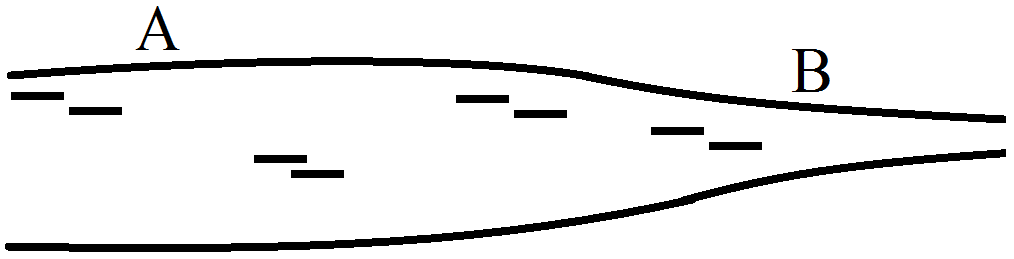
Water flows through a horizontal tube of variable cross-section. The area of cross-section at A and B are 4mm2 and 2mm2 respectively. If 1cc of water enters per second through A, find,
  1. The speed ofwater at A.
  2. The speed of water at B.
  3. Thepressure difference PA - PB.

Explain the changes occuring in the wave length, speed and frequency when light enters from one mudium to the other medium.
Give the sign convection for electric or magnetic field leaving and entering the plane of the paper.
Two bar magnets are placed close to each other with their opposite poles facing each other. In absence of other force the magnets are pulled towards each other and their kinetic energy increases. Does it contradict our earher knowledge that magnetic forces cannot do any work and hence cannot increase kinetic energy of a system?
An immersion heater rated 1000W, 220V is used to heat 0.01m3 of water. Assuming that the power is supplied at 220V and 60% of the power supplied is used to heat the water, how long will it take to increase the temperature of the water from 15°C to 40°C?
An electron accelerated by 1 kV travels 5 km towards conducting plate of infinite extension is moving in the direction perpendicular to the plate. Calculate the minimum surface charge density on the conducting plate so that the electron cannot collide with the plate.
Find the time required to liberate 1.0 litre of hydrogen at STP in an electrolytic cell by a current of 5.0A.
A radioactive nucleus A undergoes a series of decay according to following scheme:
$\text{A}\ \xrightarrow{\ \alpha\ }\ \text{A}_1\ \xrightarrow{\ \beta\ }\ \text{A}_2\ \xrightarrow{\ \alpha\ }\ \text{A}_3\ \xrightarrow{\ \text{g}\ }\ \text{A}_4$
The mass number and atomic number of A are 180 and 72 respectively. What are these numbers for A4?