Question
What is nucleus?

Answer

The most part of mass and positive charge of atom is concentrated at a tiny (space) volume, which is nucleus and around it electrons revolves just like planets revolves around the sun.

Need a full question paper?

Generate a complete, print-ready paper with questions like this in minutes — across 16+ boards, with answer keys.
Start Generating Free

Similar questions

The steam point and the ice point of a mercury thermometer are marked as $80^\circ$ and $20^\circ .$ What will be the temperature on a centigrade mercury scale when this thermometer reads $32^\circ ?$
What is the importance of binding energy per nucleon ?
An infinite line charge produces a field of $9 \times 10^4 N/C$ at a distance of $2 \ cm.$ Calculate the linear charge density.
"The total energy of the electron in the hydrogen atom is negative." What does this fact indicate? If the total energy of the electron was positive than what result will have been achieved?
Why is there no dispersion in the light refracted through a rectangular glass slab?
Find the neutral temperature and inversion temperature of a copper-iron thermocouple if the reference junction is kept at $0^\circ C$. Use the data in the table.
 
Metal with
$a$
$b$
lead $(Pb)$
$\mu\text{V}/^\circ\text{C}$
$\mu\text{V}/^\circ(\text{C})^2$
Aluminium
$-0.47$ $0.003$
Bismuth
$-43.7$ $-0·47$
Copper
$2.76$ $0·012$
Gold
$2.90$ $0.0093$
Iron
$16.6$ $-0.030$
Nickel
$19.1$ $-0.030$
Platinum
$-1.79$ $-0.035$
Silver
$2.50$ $0.012$
Steel
$10.8$ $-0.016$
 
Length of a metallic wire is 1 m and its area of cross-section is A square meters. If this wire is stretched to double its length, then by how much percent will its resistance increase?
An iron needle is attracted to the ends of a bar magnet but not to the middle region of the magnet. Is the material making up the ends of a bar magnet different from that of the middle region?
Is a slow process always isothermal? ls a quick process always adiabatic?
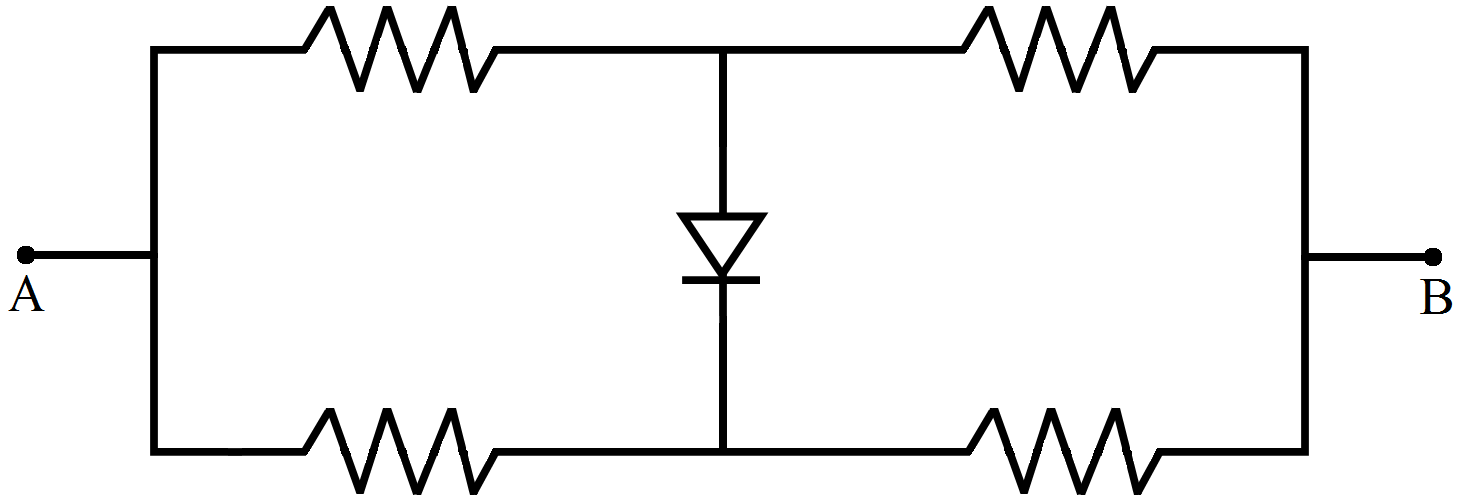
Each of the resistances shown in figure. has a value of $20\Omega.$ Find the equivalent resistance between A and B. Does it depend on whether the point A or B is at higher potential?