Question
What is osmosis?

Answer

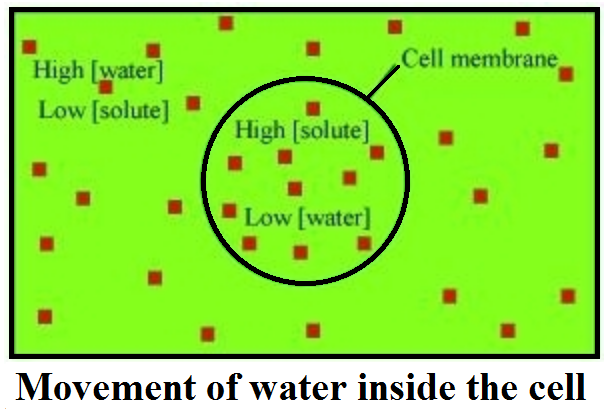
The movement of water molecules from a region of high concentration to a region of low concentration through a selectively permeable membrane is called osmosis. It is a special case of diffusion, where the medium is water. For example, if the medium surrounding the cell has a higher water concentration than the cell i.e., if the solution is a dilute solution, then the cell will gain water by osmosis.

Need a full question paper?

Generate a complete, print-ready paper with questions like this in minutes — across 16+ boards, with answer keys.
Start Generating Free

Similar questions

Define motion. What do you understand by the terms ‘uniform motion’ and ‘non-uniform motion’? Explain with examples.
Carry out the following osmosis experiment:
Take four peeled potato halves and scoop each one out to make potato cups, one of these potato cups should be made from a boiled potato. Put each potato cup in a trough containing water. Now,
  1. Keep cup A empty.
  2. Put one teaspoon sugar in cup B.
  3. Put one teaspoon salt in cup C.
  4. Put one teaspoon sugar in the boiled potato cup D.
Keep these for two hours. Then observe the four potato cups and answer the following:
  1. Explain why water gathers in the hollowed portion of B and C.
  2. Why is potato A necessary for this experiment?
  3. Explain why water does not gather in the hollowed out portions of A and D.
A ball of mass $200g$ falls from a height of $5$ metres. What is its kinetic energy when it just reaches the ground? $(g = 9.8\ m/s).$
Describe the composition of human blood.
Iron powder and sulphur powder were mixed together and divided into two parts A and B. When part A was heated strongly over a burner, then a substance C was formed. The part B was, however, not heated at all. When dilute hydrochloric acid was added to substance C, then gas D was evolved and when dilute hydrochloric acid was added to part B then gas E was evolved.
  1. What type of substance is B?
  2. What type of substance is C?
  3. Name the gas (i) D, and (ii) E?
  4. Write one characteristic property of gas D.
Write the formulae of the following compounds. Also name the elements present in them.
  1. Water.
  2. Ammonia.
  3. Methane.
  4. Sulphur dioxide.
  5. Ethanol.
Classify the following as chemical or physical changes:
  • Cutting of trees.
  • Melting of butter in a pan.
  • Rusting of almirah.
  • Boiling of water to form steam.
  • Passing of electric current, through water and the water breaking down into hydrogen and oxygen gases.
  • Dissolving common salt in water.
  • Making a fruit salad with raw fruits.
  • Burning of paper and wood.
Describe structure of a chromosome.
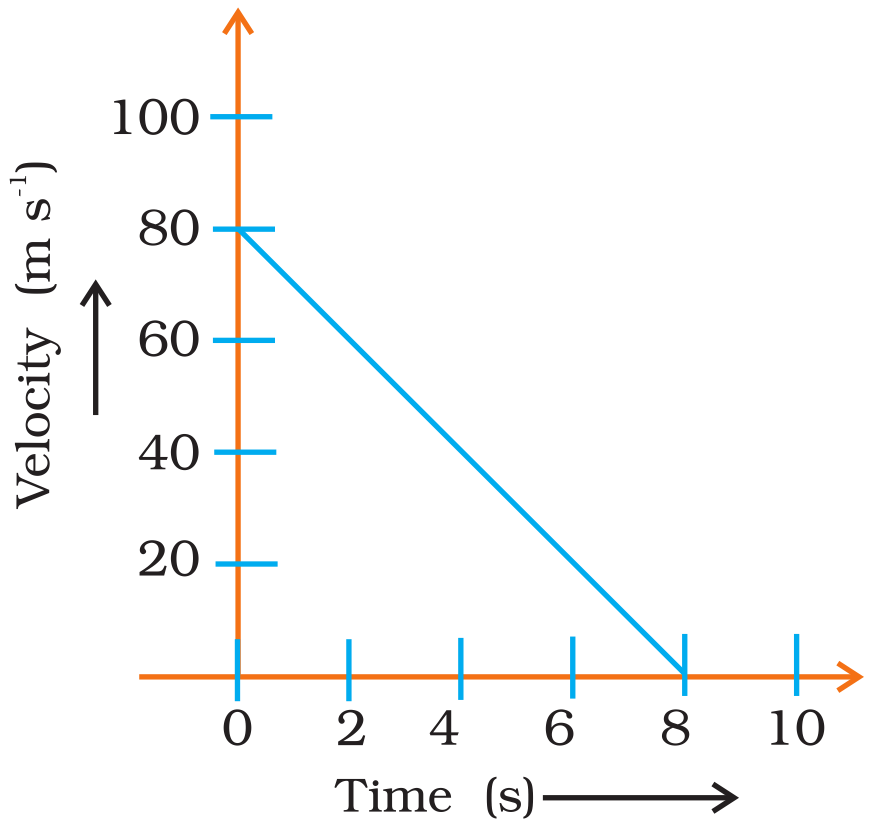
Velocity versus time graph of a ball of mass $50g$ rolling on a concrete floor is shown in Fig. Calculate the acceleration and frictional force of the floor on the ball.
A gun of mass $3\ kg$ fires a bullet of mass $30g.$ The bullet takes $0.003s$ to move through the barrel of the gun and acquires a velocity of $100\ m/s.$ Calculate:
  1. The velocity with which the gun recoils.
  2. The force exerted on gunman due to recoil of the gun.