MCQ
What is % composition of a substance?
- ASum of all the components.
- B% composition of the sum of two components.
- C% of the total mass of a substance.
- DNone of the above.
Explanation:
The percent composition of a component in a compound is the percent of the total mass of the compound that is due to that component.
Generate a complete, print-ready paper with questions like this in minutes — across 16+ boards, with answer keys.
Compound $(X)$ $\xrightarrow[{Pt}]{{5{H_2}}}$
Compound $(X)$ $\xrightarrow{{AgN{O_3}}}$ Precipitate
Compound $(X)$ $\xrightarrow[{M{e_2}S}]{{{O_3}}}$ $\begin{array}{*{20}{c}}
{\,\,\,\,\,\,\,O\,\,\,\,\,\,\,\,\,\,\,\,\,\,\,\,\,\,\,\,\,\,\,\,\,\,\,\,\,\,\,\,\,\,\,\,\,\,\,\,\,\,\,O\,\,\,\,\,\,\,\,\,\,O\,\,\,\,} \\
{\,\,\,\,\,\,\,\,\,\,\,\,\,\,\,\,\,\,\,||\,\,\,\,\,\,\,\,\,\,\,\,\,\,\,\,\,\,\,\,\,\,\,\,\,\,\,\,\,\,\,\,\,\,\,\,\,\,\,\,\,\,\,\,\,||\,\,\,\,\,\,\,\,\,\,||\,\,\,\,\,\,\,\,\,\,\,\,\,\,\,\,\,\,} \\
{H - C - C{H_2} - C{H_2} - C - C - H}
\end{array}$ $\begin{array}{*{20}{c}}
{\,\,O\,\,\,\,\,\,O\,\,\,\,\,\,\,\,\,\,} \\
{||\,\,\,\,\,\,\,\,||\,\,\,\,\,\,\,\,\,} \\
{H - C - C - O - H}
\end{array}$ $ + \begin{array}{*{20}{c}}
{O\,\,\,\,\,\,\,} \\
{||\,\,\,\,\,\,\,\,} \\
{H - C - O - H}
\end{array}$ $ + \begin{array}{*{20}{c}}
{CHO} \\
{|\,\,\,\,\,\,\,\,} \\
{CHO}
\end{array}$
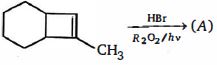
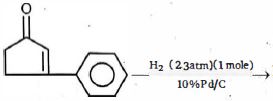
$L(1s^2, 2s^2 2p^4); Q(1s^2, 2s^2 2p^6, 3s^2 3p^5)$
$P(1s^2, 2s^2 2p^6, 3s^1); R(1s^2, 2s^2 2p^6, 3s^2)$
The formulae of ionic compounds that can be formed between these elements are