Question
What is quantization of charge?

Answer

No matter what may be the reason for the origin of charge on any charged object, the charge is always an absolute multiple of the charge of the electron, not a fractional multiple. In mathematical form $q= \pm$ ne where $n=$ integer multiple number $i . e . n =0,1,2,3, \ldots$

Need a full question paper?

Generate a complete, print-ready paper with questions like this in minutes — across 16+ boards, with answer keys.
Start Generating Free

Similar questions

The voice of a person, who has inhaled helium, has a remarkably high pitch. Explain on the basis of resonant vibration of vocal cord filled with air and with helium.
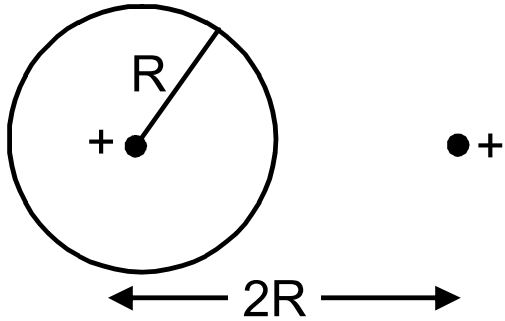
Find the flux of the electric field through a spherical surface of radius R due to a charge of 10-7C at the centre and another equal charge at a point 2R away from the centre.

Find the wavelength of electromagnetic waves of frequency 5 × 10¹⁹Hz in free space. Give its two applications.
Can two identical and independent sodium lamps act as coherent sources? Give reason for your answer.
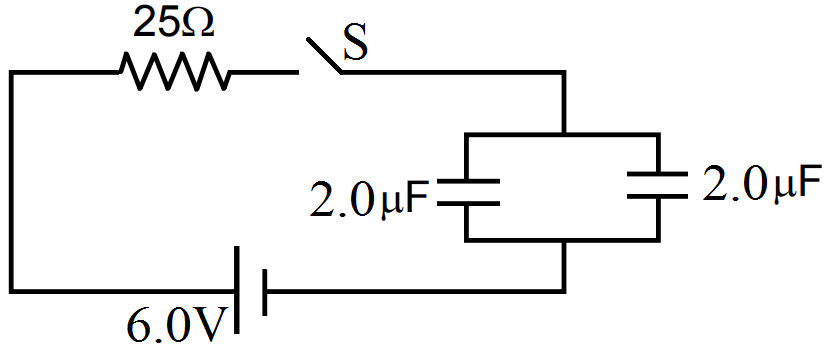
Find the charge on each of the capacitors 0.20ms after the switch S is closed in the figure.

A steel ball initially at a pressure of 1.0 × 105Pa is heated from 20°C to 120°C keeping its volume constant. Find the pressure inside the ball. Coefficient of linear expansion of steel = 12 × 10-6 °C-1 and bulk modulus of steel = 1.6 × 10¹¹Nm-2.
N small conducting liquid droplets, each of radius r, are charged to a potential V each. These droplets coalesce to form a single large drop without any charge leakage. Find the potential of the large drop.
Represent the Electric field and Magnetic field seen in the Electro magnetic waves (EM waves) in the form of equation.
Derive the relation between electric field and electric potential. Also write two important conclusions concerning this relation.
A semicircular wire of radius 5.0cm carries a current of 5.0A. A magnetic field B of magnitude 0.50T exists along the perpendicular to the plane of the wire. Find the magnitude of the magnetic force acting on the wire.