Question
What is silviculture? What are its advantages?

Answer

Silviculture is a major program started to replenish depleting forests.Its advantages are:
  1. It produces a large quantity of raw materials for industry (like timber and paper industry).
  2. It increases the area of earth under forests (which is good for the conservation of wildlife).
  3. It maintains a perfect water cycle in nature.
  4. It prevents soil erosion.
  5. It prevents floods.

Need a full question paper?

Generate a complete, print-ready paper with questions like this in minutes — across 16+ boards, with answer keys.
Start Generating Free

Similar questions

  1. Draw a sectional view of the human heart and label on it: Aorta, Pulmonary arteries, Vena cava, Left ventricle.
  2. Why is double circulation of blood necessary in human beings?
How do genes control the traits? Explain in detail.
Derive the expression for the heat produced due to a current ‘I’ flowing for a time interval ‘t’ through a resistor ‘R’ having a potential difference ‘V’ across its ends. With which name is the relation known? How much heat will an instrument of 12W produce in one minute if it is connected to a battery of 12V?
The stem of a fruit tree X fixed in soil is cut in a slanting way. The upper part of stem of another fruit tree Y of different variety of same species is also cut in a slanting way. The cut stem of tree Y, without roots but having some leaves, is placed over the rooted cut stem of tree X in such a way that their cut surfaces fit together properly. While joining the two cut stems, care is taken to make sure that the layer Z of one cut stem is in contact with layer Z of the other cut stem. The joint of cut stem is The stem of a fruit tree X fixed in soil is cut in a slanting way. The upper part of stem of another fruit bound tightly with a piece of cloth and covered properly with polythene. Soon the cut heals and the two stems grow together and become one fruit tree producing leaves, flowers and fruits.
  1. What is the name of this method of producing plants or trees?
  2. What name is given to the cut stem of tree X having roots?
  3. What name is given to the cut stem of tree Y which has no roots but has some leaves?
  4. Name the layer Z.
  5. Why should the layer Z of one cut stem be in contact with the layer Z of the other cut stem?
  6. Name any four fruit trees which are usually bred by this technique.
  7. State any one advantage of producing fruit trees by this technique.
Why is there a need for harnessing non-conventional sources of energy? How can energy be harnessed from the sea in different ways?
Describe in brief the role or,
  1. Testis.
  2. Seminal vesicle.
  3. Vas deference.
  4. Ureter.
  5. Prostate gland in human male reproductive system.
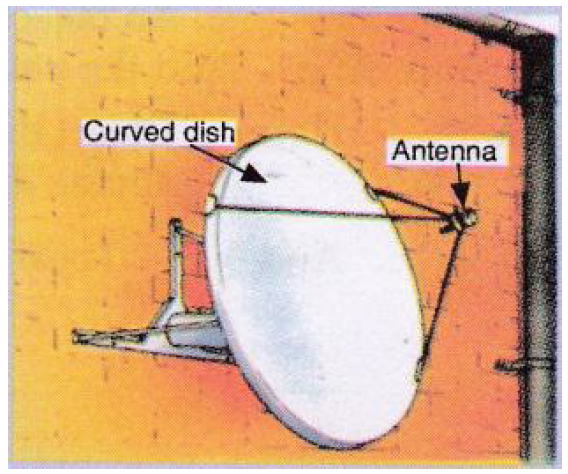
The diagram shows a dish antenna which is used to receive television signals from a satellite. The antenna (signal detector) is fixed in front of the curved dish.
  1. What is the purpose of the dish?
  2. Should it be concave or convex?
  3. Where should the antenna be positioned to receive the strongest possible signals?
  4. Explain what change you would expect in the signals if a larger dish was used.
Explain the process of nutrition in Amoeba.
i. What is saponification? Differentiate between soaps and detergents on the basis of the following:
1. Their chemical composition
2. Their mechanism in hard water
ii. Explain the formation of micelles between oily dirt and soap molecules. Also draw its diagram.
A population of red beetles lives in green bushes in a garden. Once during the process of breeding, a green beetle is produced.
  1. State whether the change in colour of beetle is a process of evolution or not.
  2. Can the new colour of green beetle be passed on to its next generations?
  3. What will be the advantage (if any) of the green colour to the beetle?
  4. State whether the production of green colour involved a change in genetic material or not.