Question
What is spermatogenesis? Briefly describe the process of spermatogenesis.

Answer

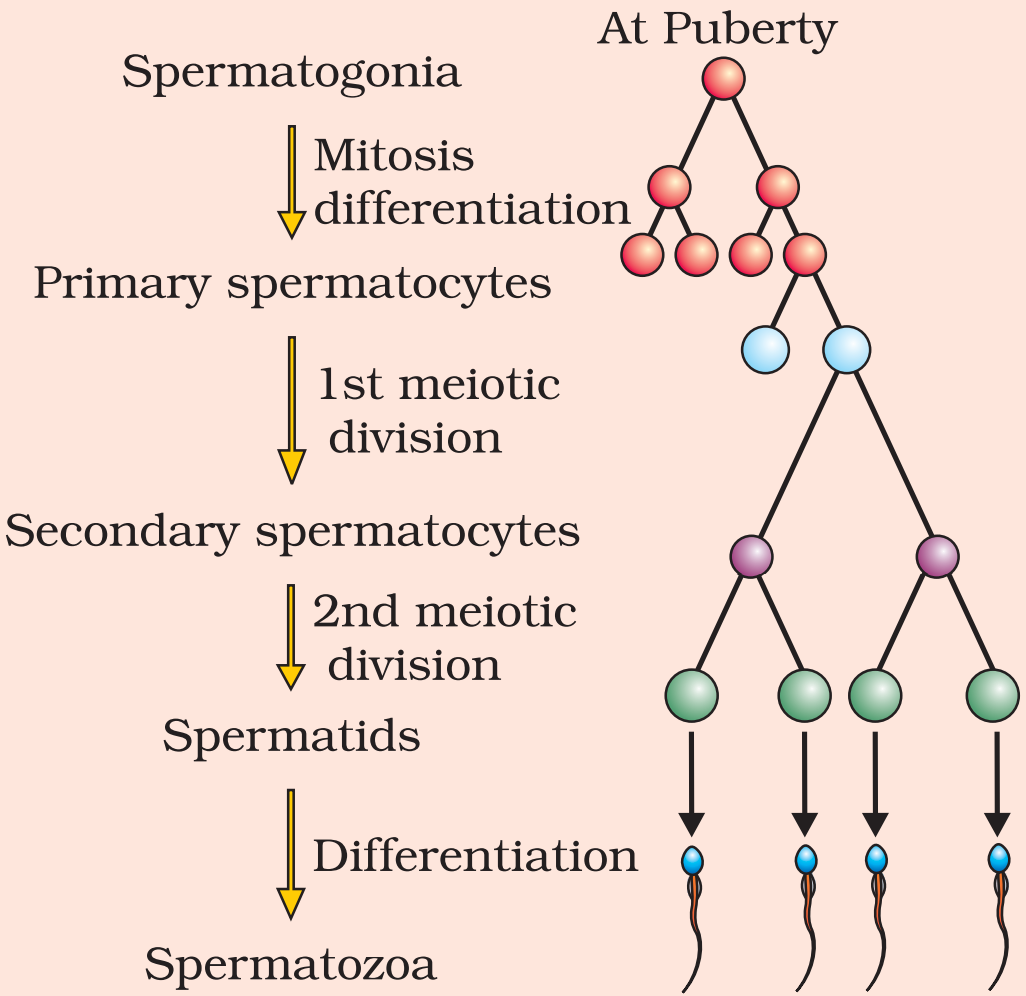
The process of the production of sperms from the immature germ cells in males is called spermatogenesis. The male germ cell of seminiferous tubules multiply mitotically to increase in numbers. Each spermatogonium is diploid and contains 46 chromosomes. Some of the spermatogonia called primary spermatocytes periodically undergo meiosis. A primary spermatocyte completes the first meiotic division (reduction division) leading to formation of two equal, haploid cells called secondary spermatocytes, which have only 23 chromosomes each. The secondary spermatocytes undergo the second meiotic division to produce four equal, haploid spermatids. The spermatids are transformed into spermatozoa (sperms) by the process called spermiogenesis.

Need a full question paper?

Generate a complete, print-ready paper with questions like this in minutes — across 16+ boards, with answer keys.
Start Generating Free

Similar questions

Give the term/ reason:
Why does zona pellucida layer block the entry of additional sperms?
Drugs like LSD, barbiturates, amphetamines, etc., are used as medicines to help patients with mental illness. However, excessive doses and abusive usage are harmful. Enumerate the major adverse effects of such drugs in humans.
  1. How does a chromosomal disorder differ from a Mendelian disorder?
  2. Name any two chromosomal aberration associated disorders.
  3. List the characteristics of the disorders mentioned above that help in their diagnosis.
Bioreactors are the inclusion carriers in any biotechnology based production process. The ultimate success of any biotechnological technique depends on the efficiency of the bioreactor due to large scale production and economy.
In the context of the above passage, answer the following questions :
(i) For optimization of a bioreactor system, list possible operating instructions (rules). Make a list of any four.
(ii) "Optimal growth and metabolic activities of cells." Mention the stages of growth mentioned in.
(iii) Is the bioproduct formed in the bioreactor completely ready for immediate use as desired? Write the appropriate reasons also to support your answer.
Differentiate between homology and analogy. Also discuss the homologous and vestigeal organs with example and how do they explain the evidence of evolution.
Show that Darwin’s natural selection is based on natural observation, with an example for each.
What is endosperm of angiosperms ? Describe its types.###What is endosperm ? Explain various types of endosperms.
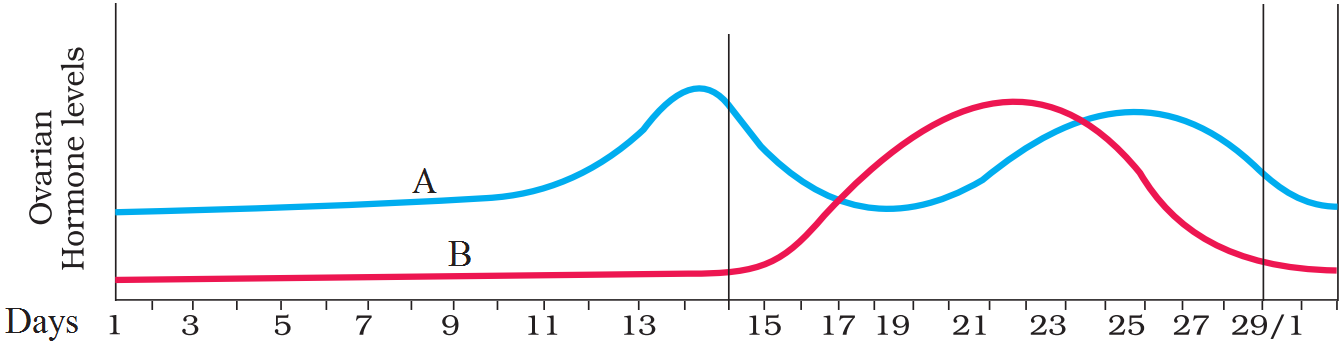
The graph given below shows the variation in the levels of ovarian hormones during various phases of menstrual cycle:

Identify ‘A’ and ‘B’.

Do you think microbes can also be used as source of energy? If yes, how?
What are the key concepts in the evolution theory of Darwin?