Question
What is stereochemistry ? Explain plane polarised light, optical activity and optical isomers.

Answer

→ Stereochemistry is the branch of that involves "the study of the different spatial arrangements of atoms in molecules".
→ Plane polarised light (PPL) when ordinary light is passed through a nicol prism a light of single wavelength vibrating in a single plane is obtained this is known as plane polarised light.
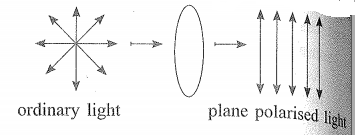
Image
→ Optical activity: "When plane polarised ligh is passed through a solution the light is rotated either in clockwise or in a anticlockwise direction by a certain angle. These types of compounds an known as optical active compound and such property is known as optical activity."
→ The angle by which the plane polarised light is rotated is measured by an instrument called polarimeter.
→ If the compound rotates the plane of plan polarised light to the right, i.e., clockwis direction, it is called dextrorotatory (Greek for right rotating) or the d-form and is indicated by placing a positive (+) sign before the degree of rotation.
→ If the light is rotated towards left (anticlockwis direction), the compound is said to be laevo rotatory or the l-form and a negative (-) sign in placed before the degree of rotation.
→ Such (+) and (-) isomers of a compound an called optical isomers and the phenomenon is termed as optical isomerism.

Need a full question paper?

Generate a complete, print-ready paper with questions like this in minutes — across 16+ boards, with answer keys.

Start Generating Free

Similar questions

Write down rules for IUPAC naming of Co ordination entities.
A 4% solution (w/w) of sucrose (M = 342 g $ mol^{-1} $) in water has a freezing point of 271.15 K. Calculate the freezing point of 5% glucose (M = 180 g $ mol^{-1} $) in water. (Given: Freezing point of pure water = 273.15 K)
Silver crystallises in fcc lattice. If edge length of the cell is $ 4.077\times10^{-8} $ cm and density is 10.5 g $ cm^{-3} $, calculate the atomic mass of silver.
The following data were obtained during the first order thermal decomposition of SO2Cl2 at a constant volume.
SO2Cl2 (g) → SO2 (g) + Cl2 (g)
Experiment Time/s-1 Total pressure/atm
1 0 0.5
2 100 0.6
Calculate the rate of the reaction when total pressure is 0.65 atm.
Discuss the formation of amine compounds by reduction of nitrile and amide compounds.
Write overall cell reaction for lead storage battery when the battery is being charged.
Conductivity of 0.00241 M acetic acid is 7.896 × 10–5 S cm–1. Calculate its molar conductivity and if $\wedge^\circ_\text{m}$ for acetic acid is 390.5 S cm2 mol–1, what is its dissociation constant?
When fruits and vegetables that have dried are placed in water, they slowly swell and return to the original form. Explain why. Would a temperature increase accelerate the process? Explain.
The following results have been obtained during the kinetic studies of the reaction.
2A + BC → D
Experiment[A]/mol L-1[B]/mol L-1Initial rate of formation of D/mol L-1 min-1
I0.10.16.0 x 10-3
II0.30.27.2 x 10-2
III0.30.42.88 × 10-1
IV0.40.12.40 x 10-2

Determine the rate law and the rate constant for the reaction.
In a reaction if the concentration of reactant A is tripled, the rate of reaction becomes twenty seven times. What is the order of the reaction?