Question
What is ten per cent law? Explain with an example.

Answer

Ten PerCent Law – According to ten per cent law, only 10 per cent of the energy entering a particular trophic level of organisms is available for transfer to the next higher trophic level.Example – Suppose 1000 Joules of light energy emitted by the sun falls on the plants. Consider a food chain:$\text{Plants}\ \ \ \rightarrow\ \ \ \text{Deer}\ \ \ \rightarrow\ \ \ \text{Lion}\\{^\text{(Producer)}}\ \ \ \ \ \ \ {^\text{(Harbivore)}}\ \ \ \ \ \ {^\text{(Carnivore)}}$
The plants or first trophic level has 10 joules of energy in it. Now according to 10 percent law, only 10% of 10 joules of energy (which is 1 joule) will be available for transfer to the next trophic level, so that the herbivore will have only 1 joule of energy stored as food at the second trophic level. 10% of the remaining 1 joule will be transferred to third trophic level of carnivore. So, the energy available in the lion as food will be only 0.1 joule.

Need a full question paper?

Generate a complete, print-ready paper with questions like this in minutes — across 16+ boards, with answer keys.

Start Generating Free

Similar questions

$i.$ Draw a labelled ray diagram to show the path of a ray of light incident obliquely on one face of a glass slab.
$ii. $Calculate the refractive index of the material of a glass slab. Given that the speed of light through the glass slab is $2 \times 10^8 m / s$ and in air is $3 \times 10^8 m / s$.
$iii.$ Calculate the focal length of a lens, if its power is $- 2.5 D.$
One half of a convex lens of focal length 10cm is covered with a black paper. Can such a lens produce an image of a complete object placed at a distance of 30cm from the lens? Draw a ray diagram to justify your answer.
A 4cm tall object is placed perpendicular to the principal axis of a convex lens of focal length 20cm. The distance of the object from the lens is 15cm. Find the nature, position and size of the image.
The image below shows a developing fetus in the mother's womb. The developing fetus is connected to the placenta by means of umbilical cord. The Umbilical vein and artery run inside the umbilical cord.
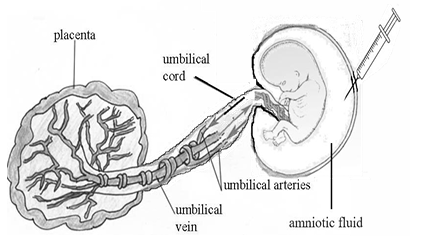
Image

(i) Name two substance that moves through the blood vessels. (1)
(ii) If the placenta has less villi how will it affect the baby's growth? (1)
(iii) Name the region where the embryo develops inside the female body. Explain how this region is adapted for nourishing the baby. (1)
(iv) Some of the fetal cells fall off into the amniotic fluid and can be collected by careful procedure. The cells were screened and found to contain XY chromosome. (2)
(a) What is the sex of the foetus?
(b) How is this prenatal sex determination misused?
A forest ecosystem having a lot of green plants has some foxes, lions and rabbits in it.
  1. Write a food chain comprising all the four organisms mentioned above.
  2. Name (i) one herbivore, and (ii) two carnivores, in this food chain.
  3. Name the link which is a predator as well as a prey.
  4. Name (i) second trophic level, and (ii) third trophic level.
  5. Which link of this food chain can feed on second trophic level as well as third trophic level, independently?
  6. If the sun provides 1000 J of energy to the plants, then how much energy will be transferred to fox through the food chain.
During the reaction of some metals with dilute hydrochloric acid, following observations were made.
  1. Silver metal does not show any change.
  2. The temperature of the reaction mixture rises when aluminium (Al) is added.
  3. The reaction of sodium metal is found to be highly explosive.
  4. Some bubbles of a gas are seen when lead (Pb) is reacted with the acid.
Explain these observations giving suitable reasons.
The liquid connective tissue A circulates in our body continuously without stopping. This tissue contains a pigment B which imparts it a colour C. The tissue A consists of four components D, E, F and G. The component D fights infection and protects us from diseases. The component E helps in the clotting of tissue A if a person gets a cut. The component F is a liquid which consists mainly of water with many substances dissolved in it and component G carries oxygen from the lungs to all the parts of the body.
  1. What is (i) tissue A, (ii) pigment B and (iii) colour C?
  2. Name (i) D, (ii) E, (iii) F and (iv) G.
  3. Name one substance (other than oxygen) which is transported by tissue A in the human body.
  4. Which two components of tissue A are the cells without nucleus?
  5. Name any two organisms (animals) which do not have liquid like A in their body.
Every household produces a lot of material A daily. In one of the methods of disposal B, material A is burned at a very high temperature of about 1000°C in a structure called C. During this process, the organic matter present is removed as D and E whereas F is left behind (which can be dumped in a landfill site).
  1. What is material A?
  2. Name the method of disposal B.
  3. What is structure C known as?
  4. What are (i) D (ii) E, and (iii) F?
  5. This method is especially suitable for the disposal of materials produced by certain institutions. Name such institutions.
Name the scientist who gave the theory of origin of life on earth. What is this theory?
You are given three resistances of 1,2 and 3 ohms. Show by diagrams, how with the help of these resistances you can get:
  1. $6\Omega$
  2. $\frac{6}{11}\Omega$
  3. $1.5\Omega$
  1. What is an electromagnet? List any two uses.
  2. Draw a labelled diagram to show how an electromagnet is made.
  3. State the purpose of soft iron core used in making an electromagnet.
  4. List two ways of increasing the strength of an electromagnet if the material of the electromagnet is fixed.