Question
What is the basic body plan of animals?

Answer

Animals have three basic body plan as given below:
  1. Cell aggregate body plan: Cells are loosely arranged and do not organise to form tissues, e.g., sponges.
  2. Blind sac body plan: Body has a cavity that helps in digestion with a single opening, the mouth, e.ge coelenterates.
  3. Tube within tube body plan: It is found in higher animal groups from nematodes to chordates. The body consists of two openings, i.e., one for ingestion and one for egestion.
It is further divided into two types:
  1. Protostomous plan: (Proto-first; stoma-mouth) found in non-chordates like flatworms, roundworms, annelids, molluscs and arthropods. In this, mouth is derived from the blastopore of the embryo and anus is formed later.
  2. Deuterostomous plan: It is found in echinoderms, hemichordata and chordates. In To this, anus is derived from the blastopore and mouth arises at the opposite end.

Need a full question paper?

Generate a complete, print-ready paper with questions like this in minutes — across 16+ boards, with answer keys.
Start Generating Free

Similar questions

Rashi was complaining about the pain in her legs since monday. Her father decided to took her to the doctor where they came to know that it was nothing, but the deficiency of calcium from which Rashi was suffering. Rashi got confused and instantly asked doctor that her teacher had taught her that the deficiency of calcium occurs in plants which causes twisting and deterioration of tissues. Doctor patiently explained her that calcium as a mineral is important for the growth of both plants and animals including human beings. Read the passage above and answer the questions that follows,
  1. Which type of element is calcium?
  2. Mention the region where requirement of calcium is maximum in plants?
  3. What other deficiency symptoms does calcium show in plants. Also give two major functions of calcium in plants?
  4. What value does the character of Rashi imparts.
How are amides formed? Name two important amides found in plants.
Terrestrial animals are generally either ureotelic or uricotelic, not ammonotelic, why?
Honeybees lead a highly socially organized life and thus are able to convert the nectar into sweet honey. Which of the following is similar to this statement? Which type of benefits those animals get which live a social life?
  1. If we learn to cooperate among ourselves then we can create immense value not only for us but also for others
  2. Teamwork is a dream-work
  3. All human beings are dependent on each other for their survival
Explain the following in terms of mycorrhizal association.
  1. Growth promotion.
  2. Antimicrobial substance.
  3. Nourishment.
  4. Adverse environment.
  5. Absorption of water.
Mention the layers of body wall of earthworm.
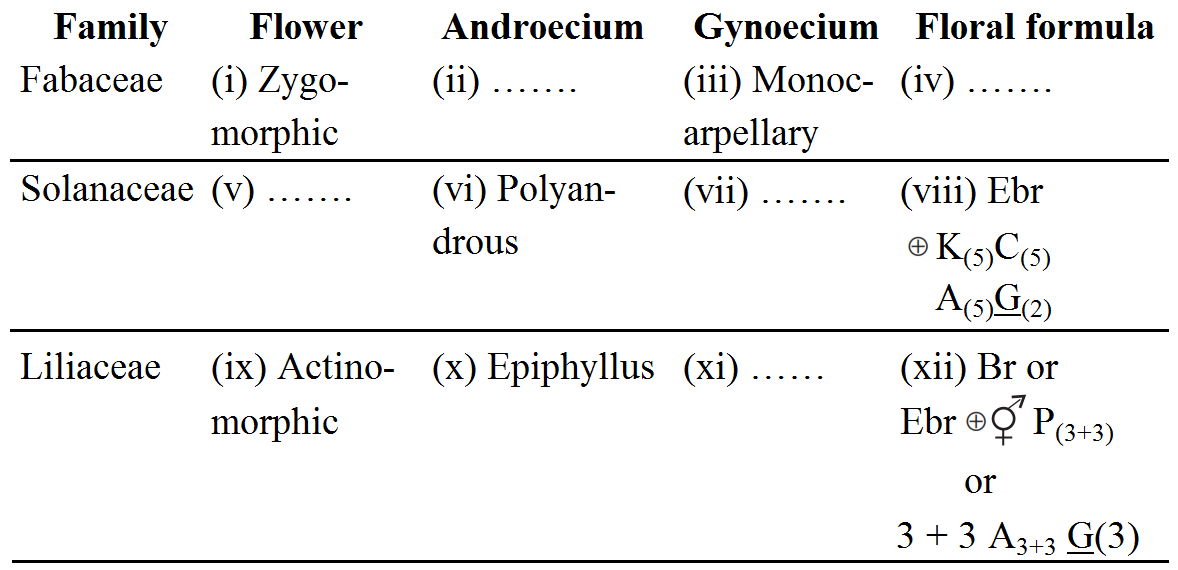
Fill in the following blanks in the table by giving correct information.
Write brief note on the following: Synaptonemal complex.
How are muscles classified based on their location? Mention their important functions.
Mention six characteristic features of dinoflagellates.