Question
What is the cartesian sign convention used for spherical mirrors?
Answer

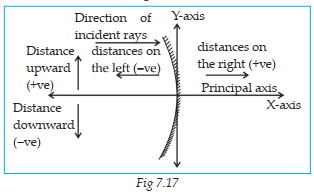
According to the cartesian sign convention, the pole of the mirror is taken as the origin. The principal axis is taken as the X-axis of the frame of reference. The sign conventions are as follows.
(i) The object is always kept on the left of the mirror. All distances parallel to the Principal axis are measured from the pole of the mirror.
(ii) All distance measured towards the right of the pole are taken to be positive, while those measured towards left are taken to be negative.
(iii) Distance measured vertically upwards from the Principal axis are taken to be positive.
(iv) Distances measured vertically downwards from the Principal axis are taken to be negative.
(v) The focal length of concave mirror is negative while that of a convex mirror is positive.

Need a full question paper?

Generate a complete, print-ready paper with questions like this in minutes — across 16+ boards, with answer keys.
Start Generating Free

Similar questions

A 5V battery is connected to two $20 Ω$ resistors which are joined together in series.
  1. Draw a circuit diagram to represent this. Add an arrow to indicate the direction of conventional current flow in the circuit.
  2. What is the effective resistance of the two resistors?
  3. Calculate the current that flows from the battery.
  4. What is the p.d. across each resistor?
Why are geostationary satellites not useful for studies of polar regions? (Practice Activity Sheet – 4)
(OR)
Explain the following statement. A geostationary satellite is not useful in the study of polar regions. (Practice Activity Sheet – 1)
Write a comparative note on usefulness and harmfulness of biotechnology.
(OR)
“Biotechnology is not only beneficial but it has some harmful effects too”. Express your opinion about this statement.
When water is added gradually to a white solid $X, $ a hissing sound is heard and a lot of heat is produced forming a product $Y.$ A suspension of $Y$ in water is applied to the walls of a house during white washing. A clear solution of $Y$ is also used for testing carbon dioxide gas in the laboratory.
  1. What could be solid $X?$ Write its chemical formula.
  2. What could be product $Y?$ Write its chemical formula.
  3. What is the common name of the solution of $Y$ which is used for testing carbon dioxide gas$?$
  4. Write chemical equation of the reaction which takes place on adding water to slid $X.$
  5. Which characteristic of chemical reactions is illustrated by this example$?$
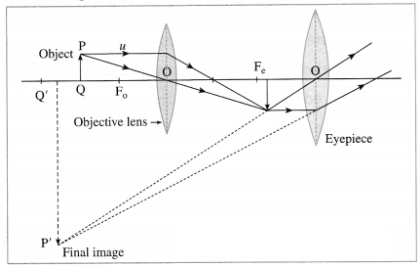
(a) In which type of microscope do you find the lens arrangement as shown in the following diagram?
Image
(b) Write in brief, the working of this microscope.
(c) Where is this microscope used?
Write short note: Post-disaster management.
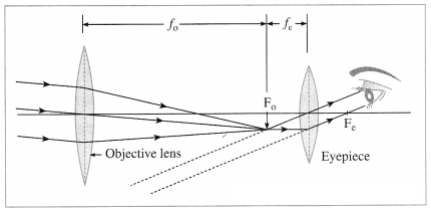
Observe the following figure and answer the questions.
(a) Which optical instrument shows arrangement of lenses as shown in the figure?
(b) Write in brief the working of this optical instrument.
Image
(c) How can we get different magnifications in this optical instrument?
(d) Draw the figure again and labelled it properly.
Which element has:
  1. Two shells, both of which are completely filled with electrons?
  2. The electronic configuration 2, 8, 2?
  3. A total of three shells, with four electrons in its valence shell?
  4. A total of two shells, with three electrons in its valence shell?
  5. Twice as many electrons in its second shell as its first shell?
What does a soda-acid type fire extinguisher contain? How does it work?
Explain the working of a soda- acid fire extinguisher with the help of a labelled diagram.
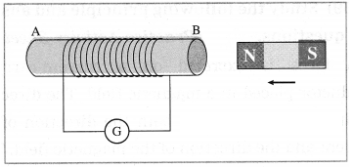
Take a coil AB having 10-15 turns. Connect the two ends of the coil to the galvanometer as shown in Figure. Take a strong bar magnet. (1) Move the north pole of the magnet towards the end B of the coil.
Image

Observe the deflection of the pointer in the galvanometer. Note the direction of the deflection (i.e. right or left). (2) Now repeat this with the south pole of the magnet towards the end B of the coil. Again observe the deflection. Note its direction. (3) What will happen if instead of the magnet, the coil is moved? (4) If both the coil and the magnet are kept stationary, do you observe any deflection? (5) Compare the direction of the deflection when the north pole of the magnet is moved towards the end B of the coil with that when the end B of the coil is moved away from the north pole of the magnet. (6) What conclusions do you draw from the observations?