Question
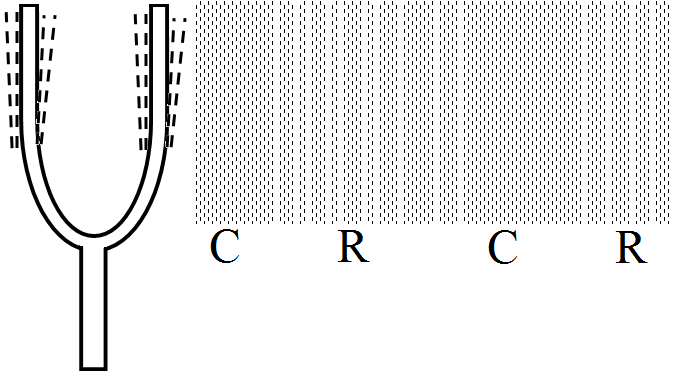
What is the difference between a compression and a rarefaction in a sound wave? Illustrate your answer with a sketch.

Answer

A compression is that part of a longitudinal wave in which the particles of the medium are closer to one another than they normally are, and there is a momentary reduction in volume of the medium. It is a region of high pressure. A rarefaction is that part of a longitudinal wave in which the particles of the medium are farther apart than normal, and there is a momentary increase in the volume of the medium. It is a region of low pressure.

Need a full question paper?

Generate a complete, print-ready paper with questions like this in minutes — across 16+ boards, with answer keys.
Start Generating Free

Similar questions

$i$. At some moment, two giant planets Jupiter and Saturn of the solar system are in the same line as seen from the earth. Find the total gravitational force due to them on a person of mass $50 \ kg$ on the earth. Could the force due to the planets be important?
Mass of the Jupiter $= 2 x \ 1027 \ kg$
Mass of the Saturn $= 6 x \ 1026 \ kg$
The distance of Jupiter from the earth $= 6.3 x \ 10 \ m$
The distance of Saturn from the earth $= 1.28 x \ 1012 \ m$
$ii$. A bag of sugar weighs $'w\ '$ at a certain place on the equator. If this bag is taken to Antarctica, then will it weigh the same or more or less. Give a reason for your answer.
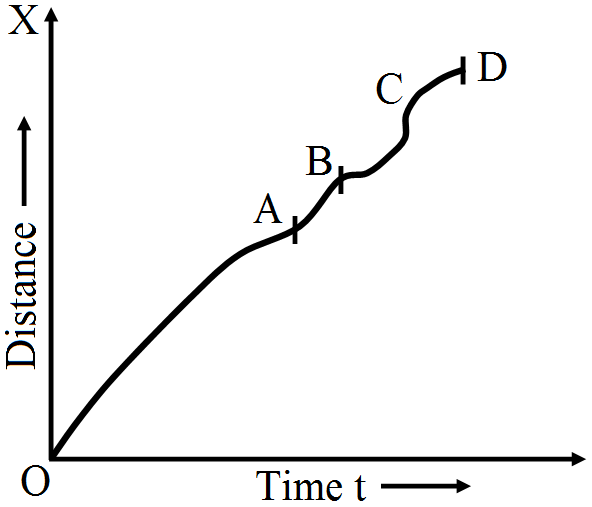
The figure shows an $x-t$ graph of a particle moving along a straight line. What is the sign of the acceleration during the intervals $OA, AB, BC,$ and $CD?$
Write the formulae of the following compounds. Also name the elements present in them.
  1. Water.
  2. Ammonia.
  3. Methane.
  4. Sulphur dioxide.
  5. Ethanol.
A liquid compound $X$ of molecular mass $18u$ can be obtained from a number of natural sources. All the animals and plants need liquid $X$ for their survival. When an electric current is passed through $200$ grams of pure liquid $X$ under suitable conditions, then $178$ grams of gas $Y$ and $22$ grams of gas $Z$ are produced. Gas $Y$ is produced at the positive electrode whereas gas $Z$ is obtained at the negative electrode. Moreover, gas $Y$ supports combustion whereas gas $Z$ burns itself causing explosions.
  1. Name $(i)$ liquid $X$ $(ii)$ gas $Y$, and $(iii)$ gas $Z$
  2. What is the ratio to the mass of element $Z$ to the mass of element $Y$ in the liquid $X$?
  3. Which law of chemical combination is illustrated by this example?
  4. Name two sources of liquid $X$.
  5. Gate an important use of $Y$ in our life.
An atom of element $E$ contains $3$ protons, $3$ electrons and $4$ neutrons:
  1. What is its atomic number?
  2. What is its mass number?
  3. Write the electronic configuration of the element $E$.
  4. State whether element $E$ is a metal or non-metal. Why?
  5. What type of ion, cation or anion, will be formed by an atom of element $E$? Why?
  6. Write the symbol of the ion formed by an atom of element $E$.
  7. What could element $X$ be?
Name the gases that cause air pollution other than carbon dioxide.
Describe the structure and functions of epithelium.
What is the role of $SER$ in liver cells of vertebrates?
Draw a labelled diagram of human ear and discuss the function of its parts and its working.
What is endoplasmic reticulum? Give its types and functions.