Question
What is the difference between a full Moon and a new Moon? After how many days a full Moon changes into a new Moon?

Answer

There is a change in the shape of moon every day. There are days when the shape of moon appears perfectly round. Also, there are days when the moon cannot be seen at all even if the sky is clear. The day on which the whole disc of the moon is visible is called the full Moon day. Every night, the size of the bright part of the moon appears to become thinner and thinner. On the fifteenth day, the moon is not visible. This day is called the new Moon day. The next day, only a small portion of the moon appears in the sky. This is known as the crescent moon. Then again, the moon grows larger every day. On the fifteenth day once again we get a full view of the moon. After fifteen days, the full moon changes into a new Moon.
Need a full question paper?

Generate a complete, print-ready paper with questions like this in minutes — across 16+ boards, with answer keys.

Start Generating Free

Similar questions

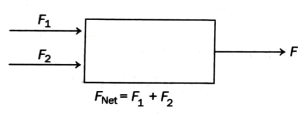
Resultant forces considered in following situations
(i) If the two forces act in the same direction on a body, the net force acting on it is the sum of two forces.
Image
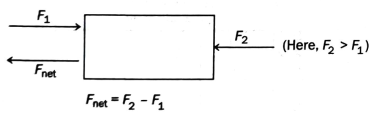
(ii) If the two forces act in the opposite directions on a body, the net force acting on it is the difference between two forces.
Image
Suppose, two forces of 15 N and 30 N act on a body from the left hand side, while another force of 35 N acts on it from the right hand side. Find the resultant of the force and its direction.
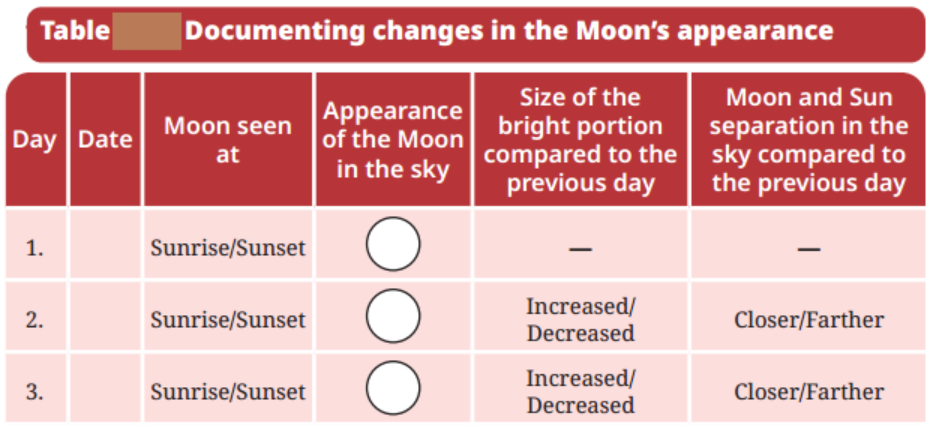
Documenting Changes in the Moon’s Appearance
Image
Q.1. Did the Moon appear different each day?
Q.2. Was the Moon visible on all days?
Q.3. Did the Moon appear at the same position in the sky as on the previous day?
What is meant by an ‘embryo’? Can we identify the body features in an embryo?
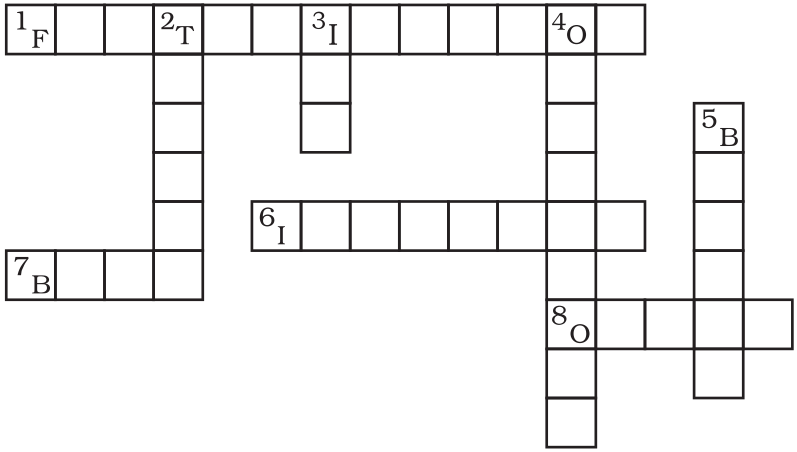
Complete the crossword puzzle using the hints given below.
Across:
$1.$ The process of the fusion of the gametes.
$6.$ The type of fertilisation in hen.
$7.$ The term used for bulges observed on the sides of the body of hydra.
$8.$ Eggs are produced here.
Down:
$2.$ Sperms are produced in these male reproductive organs.
$3.$ Another term for in vitro fertilisation.
$4.$ These animals lay eggs.
$5.$ A type of fission in amoeba.
​​​​​​​
Grains of rice and rice flour take the shape of the container when placed in different jars. Are they solids or liquids? Explain.
Give the important uses of nylon.
Are the laws of reflection applicable to spherical mirrors also?
What is smog? How is smog formed? What are its harmful effects?
In a candle flame, what is the colour of: $(a)$ innermost zone $(b)$ middle zone, and $(c)$ outer zone?
What is meant by ‘reproduction’? why is it essential?