Question
What is the difference between cathode rays and beta rays? When the two are travelling in space, can you make out which is the cathode ray and which is the beta ray?

Answer

Cathode rays consist of electrons that are accelerated using electrodes. They do not carry high energy and do not harm human body. On the other hand, beta rays consist of highly energetic electrons that can even penetrate and damage human cells. Beta rays are produced by the decay of radioactive nuclei. If the two are travelling in space, they can be distinguished by the phenomenon named production of Bremsstrahlung radiation, which is produced by the deceleration of a high energy particle when deflected by another charged particle, leading to the emission of blue light. Only beta rays are capable of producing it.
Need a full question paper?

Generate a complete, print-ready paper with questions like this in minutes — across 16+ boards, with answer keys.

Start Generating Free

Similar questions

  1. Differentiate between three segments of a transistor on the basis of their size and level of doping.
  2. How is a transistor biased to be in active state?
  3. With the help of necessary circuit diagram, describe briefly how $n-p-n$ transistor in $CE$ configuration amplifies a small sinusoidal input voltage. Write the expression for the ac current gain.
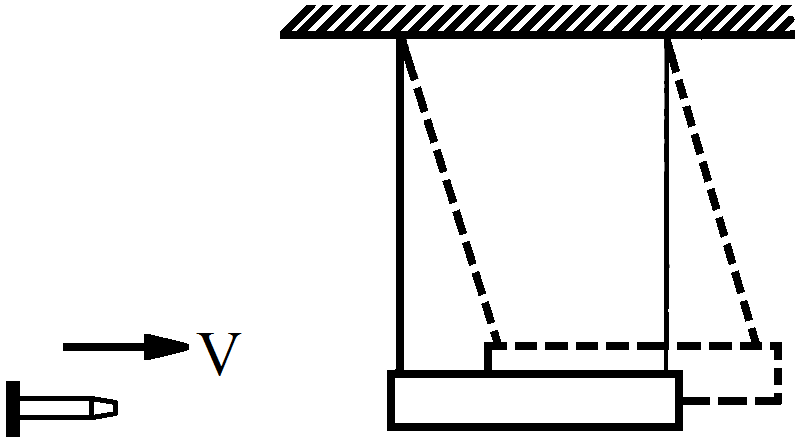
A gun of mass M fires a bullet of mass m with a horizontal speed V. The gun is fitted with a concave mirror of focal length f facing tpwards the receding bullet. Find the speed of separation of the bullet and the image just after the gun was fired.
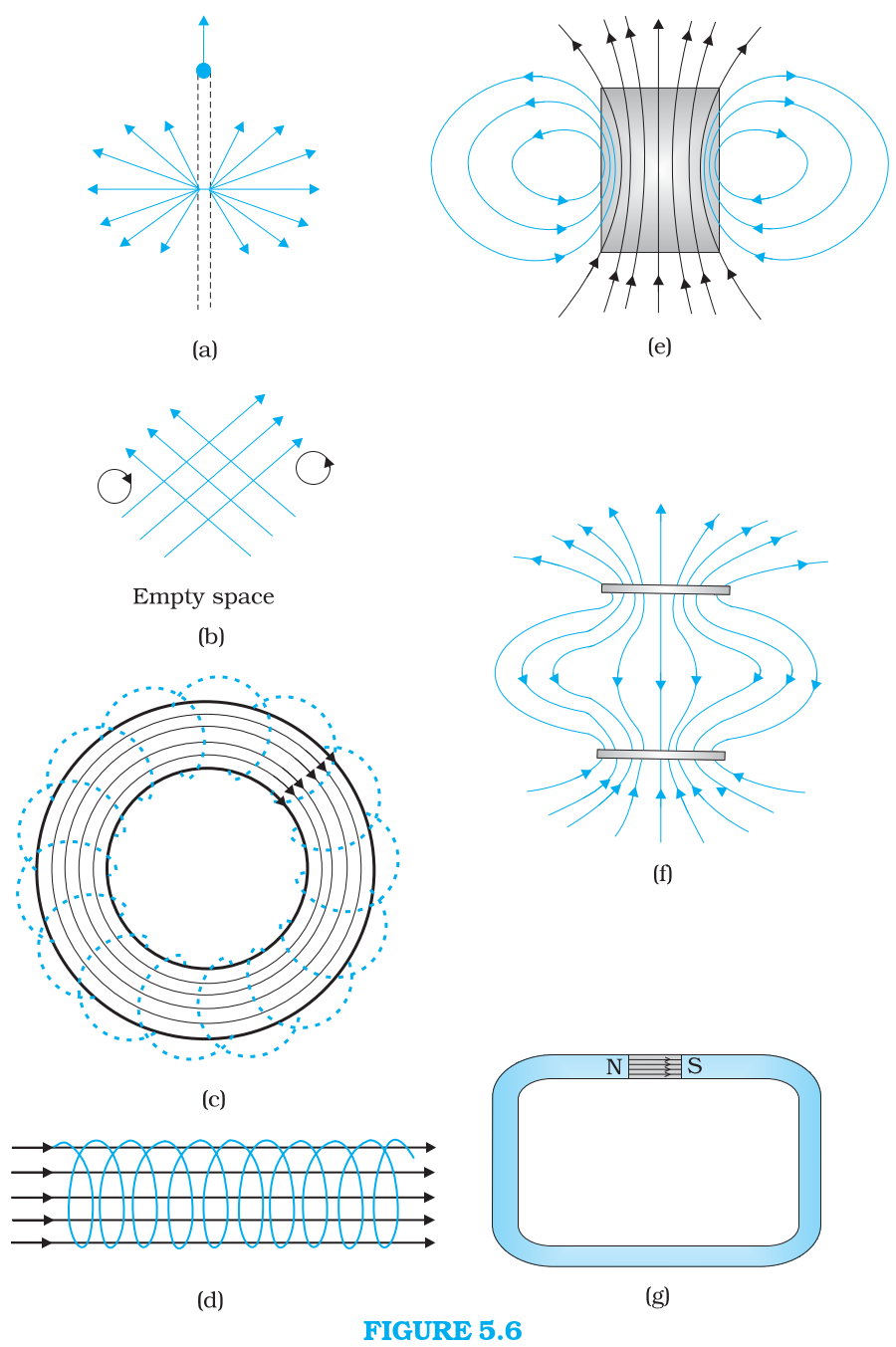
Many of the diagrams given in Fig. 5.7 show magnetic field lines (thick lines in the figure) wrongly. Point out what is wrong with them. Some of them may describe electrostatic field lines correctly. Point out which ones.
Image
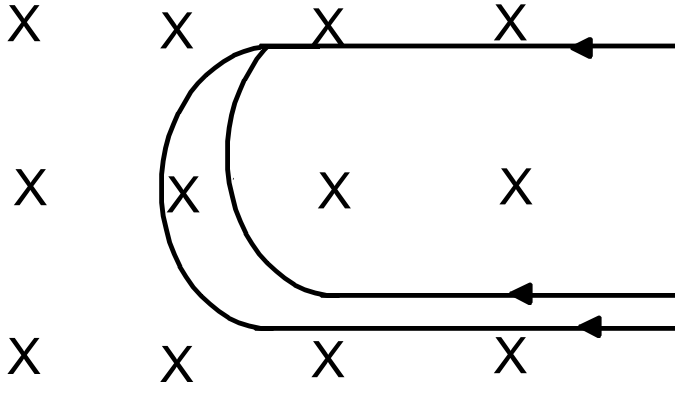
A narrow beam of singly$-$charged carbon ions, moving at a constant velocity of $6.0 \times 10^4m s^{-1}$, is sent perpendicularly in a rectangular region of uniform magnetic field $B = 0.5T$ It is found that two beams emerge from the field in the backward direction, the separations from the incident beam being $3.0\ cm$ and $3.5\ cm$. Identify the isotopes present in the ion beam. Take the mass of an ion $= A(1.6 \times 10^{-27})kg$, where A is the mass number.
A force $F_1$ acts on a particle so as to accelerate it from rest to a velocity $v.$ The force $F_1$ is then replaced by $F_2$ which decelerates it to rest:
A block of mass $200g$ is suspended through a vertical spring. The spring is stretched by $1.0\ cm$ when the block is in equilibrium. A particle of mass $120g$ is dropped on the block from a height of $45\ c$m. The particle sticks to the block after the impact. Find the maximum extension of the spring. Take $g = 10m/s^2.$
​​​​​​​
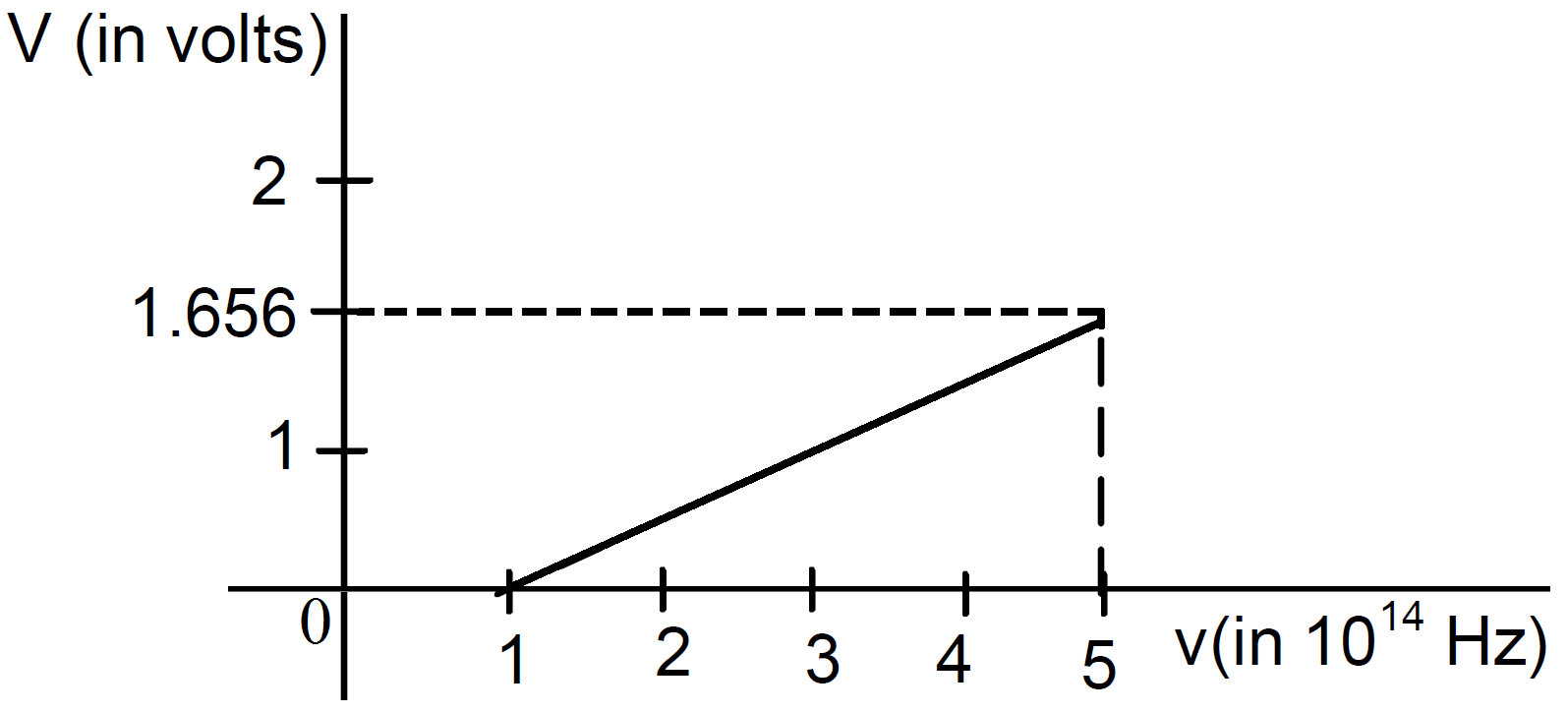
Figure is the plot of the stopping potential versus the frequency of the light used in an experiment on photoelectric effect. Find.
  1. The ratio $h/e$ and.
  2. The work function.
A polythene piece rubbed with wool is found to have a negative charge of $3 \times 10^{-7} C$.
(a) Estimate the number of electrons transferred (from which substance to which substance).
(b) Is there a transfer of mass from wool to polythene?
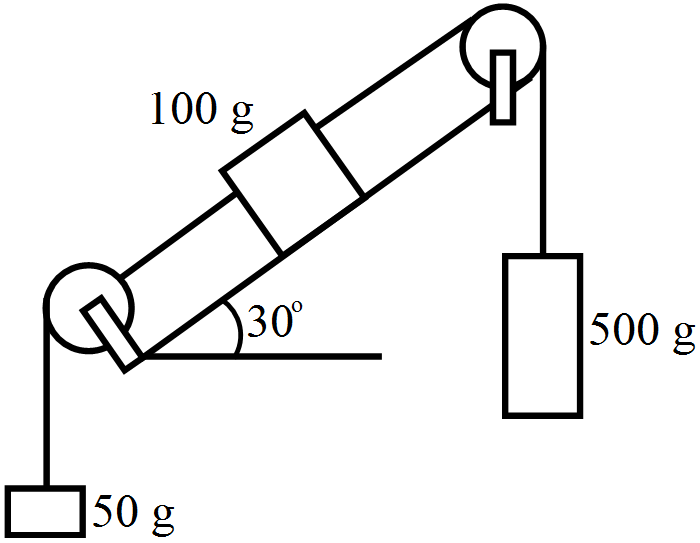
Find the acceleration of the $500g$ block in figure.
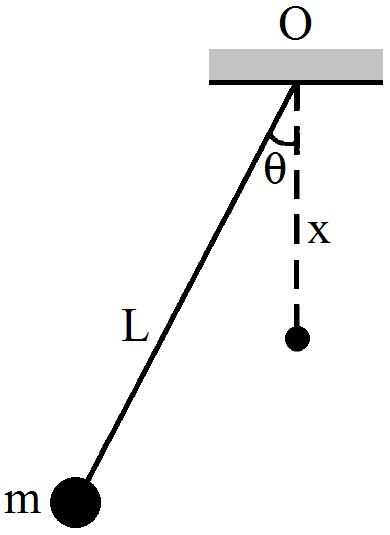
A simple pendulum of length $L$ having a bob of mass m is deflected from its rest position by an angle $\theta$ and released $($figure$)$. The string hits a peg which is fixed at a distance $x$ below the point of suspension and the bob starts going in a circle centred at the peg.
  1. Assuming that initially the bob has a height less than the peg, show that the maximum height reached by the bob equals its initial height.
  2. If the pendulum is released with $\theta=90^\circ$ and $\text{x}=\frac{\text{L}}{2}$ find the maximum height reached by the bob above its lowest position before the string becomes slack.
  3. Find the minimum value of $\frac{\text{x}}{\text{L}}$ for which the bob goes in a complete circle about the peg when the pendulum is released from $\theta=90^\circ.$