Question
What is the difference between cathode rays and beta rays? When the two are travelling in space, can you make out which is the cathode ray and which is the beta ray?

Answer

Cathode rays consist of electrons that are accelerated using electrodes. They do not carry high energy and do not harm human body. On the other hand, beta rays consist of highly energetic electrons that can even penetrate and damage human cells. Beta rays are produced by the decay of radioactive nuclei. If the two are travelling in space, they can be distinguished by the phenomenon named production of Bremsstrahlung radiation, which is produced by the deceleration of a high energy particle when deflected by another charged particle, leading to the emission of blue light. Only beta rays are capable of producing it.
Need a full question paper?

Generate a complete, print-ready paper with questions like this in minutes — across 16+ boards, with answer keys.

Start Generating Free

Similar questions

A regular polygon of n sides is formed by bending a wire of total length $27\pi\text{r}$ which carries a current i.
  1. Find the magnetic field B at the centre of the polygon.
  2. By letting $\text{n}\rightarrow\infty,$ deduce the expression for the magnetic field at the centre of a circular current.
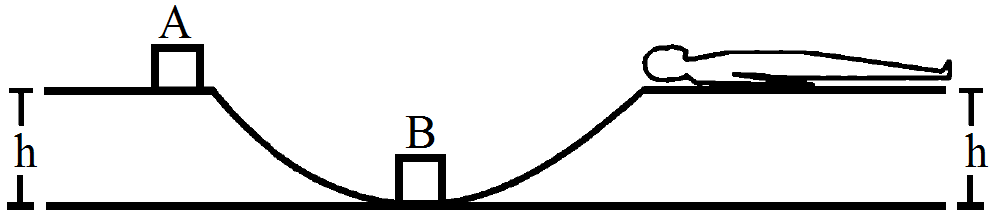
The track shown in figure is frictionless. The block B of mass 2m is lying at rest and the block A of mass m is pushed along the track with some speed. The collision between A and B is perfectly elastic. With what velocity should the block A be started to get the sleeping man awakened?
Suppose the space between the two inner shells of the previous problem is filled with a dielectric of dielectric coastant K. Find the capacitance of the system between A and B.
Explain the principle of superposition in terms of position vectors of charges.
A metre scale is made up of steel and measures correct length at $16^{\circ} \mathrm{C}$. What will be the percentage error if this scale is used:
  1. On a summer day when the temperature is $46^{\circ} \mathrm{C}$.
  2. On a winter day when the temperature is $6^{\circ} \mathrm{C}$ ? Coefficient of linear expansion of steel $=11 \times 10^{-6}{ }^{\circ} \mathrm{C}^{-1}$.
An electron of kinetic energy 100eV circulates in a path of radius 10cm in a magnetic field. Find the magnetic field and the number of revolutions per second made by the electron.
A uniform magnetic field B exist in a region. An electron projected perpendicular to the field goes in a circle. Assuming Bohr's quantization rule for angular momentum, calculate (a) the smallest possible radius of the electron (b) the radius of the nth orbit and (c) the minimum possible speed of the electron.
(II) (a) With the help of a diagram, explain the principle of a device which changes a low ac voltage into a high voltage . Deduce the expression for the ratio of secondary voltage to the primary voltage in terms of the ratio of the number of turns of primary and secondary winding. For an ideal transformer, obtain the ratio of primary and secondary currents in terms of the ratio of the voltages in the secondary and primary coils.
(b) Write any two sources of the energy losses which occur in actual transformers.
(c) A step-up transformer converts a low input voltage into a high output voltage. Does it violate law of conservation of energy? Explain.
Find the total heat produced in the loop of the previous problem during the interval 0 to 30s if the resistance of the loop is $4.5\text{m}\Omega.$
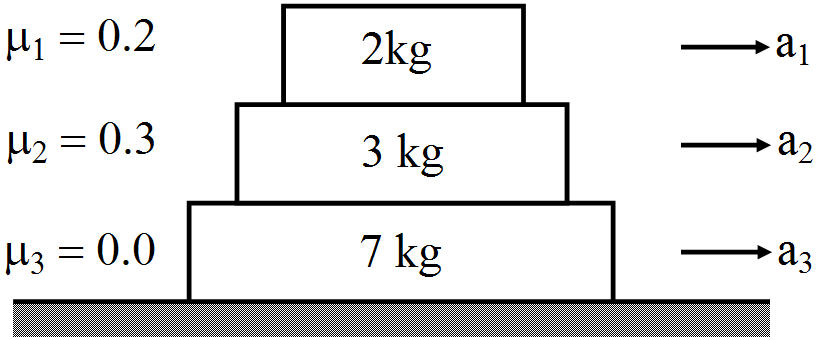
Find the accelerations $a_1, a_2, a_3$ of the three blocks shown in figure if a horizontal force of 10N is applied on:
  1. 2kg block.
  2. 3kg block.
  3. 7kg block. Take $g = 10m/s^2.$