Question
What is the difference between glucose and starch?

Answer

(i) Glucose does not react with iodine solution whereas starch gives blue colour with iodine solution.
(ii) Glucose does not undergo hydrolysis whereas hydrolysis of starch gives glucose.
(iii) Glucose gives red precipitate with Fehling's solution but starch does not give this test.

Need a full question paper?

Generate a complete, print-ready paper with questions like this in minutes — across 16+ boards, with answer keys.
Start Generating Free

Similar questions

Write the chemical equations involved in the following reactions:

  1. Hoffmann-bromamide degradation reaction.
  2. Carbylamine reaction.


What is essentially the difference between a-form of glucose and b-form of glucose? Explain.
Calculate the emf of the cell in which the following reaction takes place Ni(s) + 2Ag+ (0.002 M) → Ni2+ (0.160 M) + 2Ag(s)
Given that $\text{E}^\ominus_{(\text{cell})}$ = 1.05 V
Given that the standard electrode potentials (Eo) of metals are:
K+/K = –2.93 V, Ag+/Ag = 0.80 V, Cu2+/Cu = 0.34 V,
Mg2+/Mg = -2.37 V, Cr3+/Cr = – 0.74 V, Fe2+/Fe = – 0.44 V.
Arrange these metals in an increasing order of their reducing power. 
The partial pressure of ethane over a solution containing 6.56 × 10⁻³ g of ethane is 1 bar. If the solution contains 5.00 × 10⁻² g of ethane, then what shall be the partial pressure of the gas?
Compound (A) is formed when benzene diazonium chloride is mixed with KI solution. Compound (B) is formed when ( A ) reacts with sodium in the presence of dry ether. Write the names of (A) and (B) and the equations of the chemical reactions involved.
Name two water soluble vitamins, their sources and the diseases caused due to their deficiency in diet.
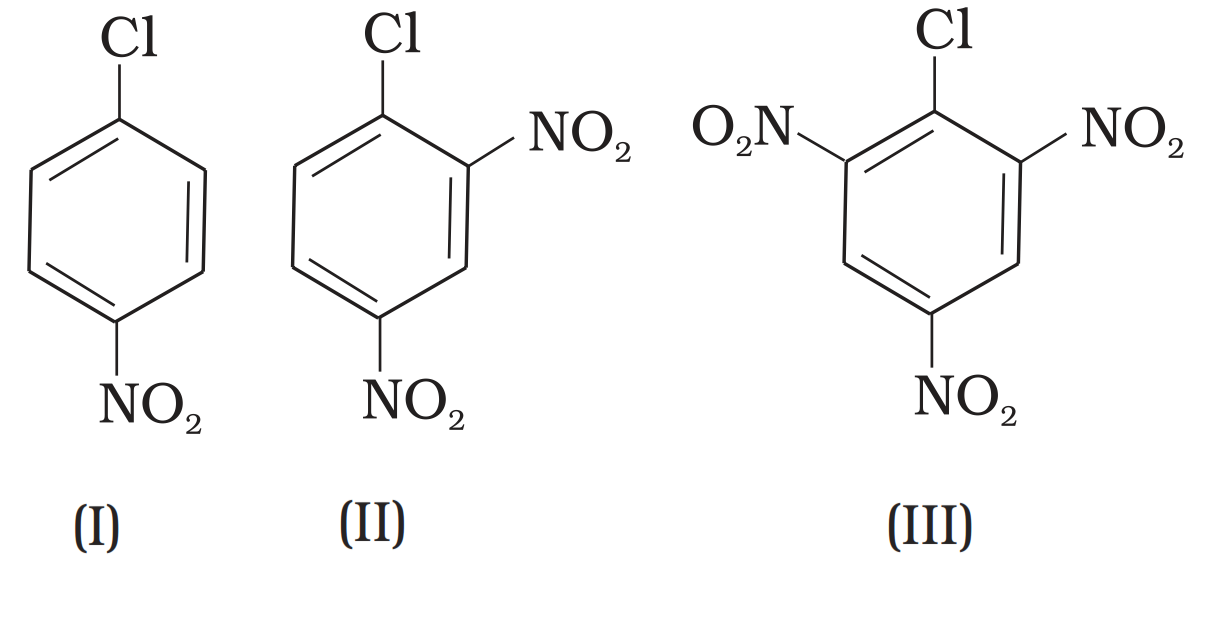
Aryl halides are extremely less reactive towards nucleophilic substitution. Predict and explain the order of reactivity of the following compounds towards nucleophilic substitution:

Define the following term (1) Coordination sphere (2) Oxidation number of central atom
Explain density of Haloalkane Compound.