Question
What is the difference between lanthanoids and actinoids?

Answer

Difference between Lanthanoids and Actinoids:
LanthanoidsActinoids
1. Besides +3 oxidation state, they show +2 and +4 oxidation states only in few cases.1. Besides +3 oxidation state, they show higher oxidation states of +4 , $+5,+6$ and +7 also.
2. Most of their ions are colourless.2. Most of their ions are coloured.
3. They have less tendency towards complex forma-tion.3. They have greater ten-dency towards complex formation.
4. Lanthanoid compounds are less basic.4. Actinoid compounds are more basic.
5. Do not form oxocations.5. From oxocations e.g. $UO _2^{2+}, PuO _2^{2+}$ and $UO ^{+}$.
6. Except promethium, they are non-radioactive.6. They are radioactive.
7. Their magnetic properties can be explained easily.7. Their magnetic properties cannot be explained easily.

Need a full question paper?

Generate a complete, print-ready paper with questions like this in minutes — across 16+ boards, with answer keys.
Start Generating Free

Similar questions

  1. When $2.56\ g$ of sulphur was dissolved in $100\ g$ of $CS_2,$ the freezing point lowered by $0.383\ K.$ Calculate the formula of sulphur $(S_x).$
$(K_f$ for $CS_2 = 3.83 K \ kg\ mol^{–1},$ Atomic mass of Sulphur $= 32\ g\ mol^{–1}]$
  1. Blood cells are isotonic with $0.9\%$ sodium chloride solution. What happens if we place blood cells in a solution containing.
  1. $1.2\%$ sodium chloride solution?
  2. $0.4\%$ sodium chloride solution?
  1. What is meant by:
  1. Colligative properties.
  2. Molality of a solution.
  1. What concentration of nitrogen should be present in a glass of water at room temperature ? Assume a temperature of $25^\circ C,$ a total pressure of $1$ atmosphere and mole fraction of nitrogen in air of $0.78. [K_H $ for nitrogen $= 8.42 x 10^{–7}\ M/mm\ Hg].$
Attempt any five of the following:
(a) What is the structural feature characterising reducing sugars?
(b) What type of linkage is present in polysaccharides?
(c) Give examples of fat soluble vitamins.
(d) The two strands in DNA are not identical but are complementary. Explain.
(e) Write uses of B-Complex.
(f) Name the disaccharide which on hydrolysis gives two molecules of glucose.
(g) Name purines present in DNA?
  1. Define the following terms:
  1. Mole fraction.
  2. Van’t Hoff factor.
  1. $100\ mg$ of a protein is dissolved in enough water to make $10.0\ mL$ of a solution. If this solution has an osmotic pressure of $13.3\ mm\ Hg$ at $25^\circ C,$ what is the molar mass of protein$?$
$(R = 0.0821\ L\ atm\ mol^{–1} K^{–1}$ and $760\ mm\ Hg = 1\ atm.)$
  1. Following are the transition metal ions of 3d series:
$Ti^{4+}, V^{2+}, Mn^{3+}, Cr^{3+}$
$($Atomic numbers : $Ti = 22, V = 23, Mn = 25, Cr = 24)$
Answer the following:
  1. Which ion is most stable in an aqueous solution and why?
  2. Which ion is a strong oxidising agent and why?
  3. Which ion is colourless and why?
  1. Complete the following equations:
  1. $2\text{ }\text{MnO}_4^-+16\text{ }\text{H}^++5\text{ }\text{S}^{2-}\xrightarrow{\text{ }\text{ }\text{ }\text{ }\text{ }\text{ }\text{ }\text{ }\text{ }\text{ }\text{ }}$
  1. $\text{KMnO}_4\xrightarrow{\text{ }\text{ }\text{ }\text{ }\text{ }\text{heat}\text{ }\text{ }\text{ }\text{ }\text{ }}$
Explain the various methods of preparation of $CHCl _3$ and its chemical properties.
Attempt any five of the following:
$(a)$ Deficiency of which vitamin causes night-blindness.
$(b)$ Give two examples of reducing sugars.
$(c)$ Define the following terms:
$i.$ Glycosidic linkage
$ii.$ Native protein
$(d)$ Write function of carbohydrates in plants.
$(e)$ Differentiate between:
$i.$ Peptide linkage and Glycosidic linkage
$ii.$ Nucleoside and Nucleotide
$(f)$ What type of linkage holds together the monomers of $\text{DNA}$?
$(g)$ Write the product obtained when $D-$glucose reacts with $H_2N-OH.$
Answer the following questions:
Give reasons:
  1. d-block elements exhibit more oxidation states than f-block elements.
  2. Orange solution of potassium dichromate turns yellow on adding sodium hydroxide to it.
  3. Zirconium (Z = 40) and Hafnium (Z = 72) have almost similar atomic radii.
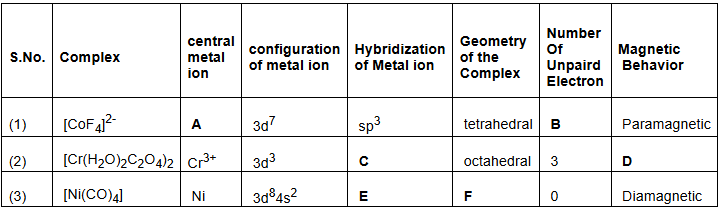
$(a).$ Using, Valence Bond Theory identify $\ce{A, B, C, D, E}$ and $\ce{F}$ in the following table$:$​​​​​​​
Image
$(b).$ Write the ionic equations for the reaction of acidified $\ce{K_2Cr_2O_7}$ with
$\ce{(i) H_2S}$ and $\ce{(ii) FeSO_4}​​​​​​​$​​​​​​​
State Henry's law and mention some important applications.