Question
What is the difference between speed and velocity?

Answer

SpeedVelocity
(i) The distance covered by a body in unit time is called its speed.(i) The distance a body travels in a certain direction in unit time is called its velocity.
(ii) It is a scalar quantity.(ii) This is a vector.
(iii) Speed is always positive.(iii) Velocity can be positive, negative or zero.
(iv) It senses only the magnitude of motion.(iv) In this, along with the magnitude of speed, there is also a sense of direction.

Need a full question paper?

Generate a complete, print-ready paper with questions like this in minutes — across 16+ boards, with answer keys.
Start Generating Free

Similar questions

Answer the following questions:A man with a wristwatch on his hand falls from the top of a tower. Does the watch give correcttime during the free fall?
A physical quantity X is given by: $\text{X}=\frac{\text{P}^2\text{Q}^{\frac{3}{2}}}{\text{R}^4\text{S}^{\frac{1}{2}}}$ The percentage errors in P, Q, R and S are 1%, 2%, 4% and 2%. Calculate the percentage error in X.
Explain the isobaric process.
One person says that the potential energy of a particular book kept in an almirah is 20J and the other says it is 30J. Is one of them necessarily wrong?
Two cylinders A and B of equal capacity are connected to each other via a stopcock. A contains a gas at standard temperature and pressure. B is completely evacuated. The entire system is thermally insulated. The stopcock is suddenly opened. Answer the following: Do the intermediate states of the system (before settling to the final equilibrium state) lie on its P-V-T surface?
Calculate the ratio of the mean free paths of the molecules of two gases having molecular diameters 1 A and 2 A. The gases may be considered under identical conditions of temperature, pressure and volume.
If the earth stops rotating about its own axis, what is the effect on the value of weight of any object on the surface of earth?
Two trains of lengths 109 m and 91 m are moving in opposite directions with velocities $34 \mathrm{~km} \mathrm{~h}^{-1}$ and $38 \mathrm{~km} / \mathrm{h}^{-1}$ respectively. In what time the two trains will completely cross each other? Choose the most logical reference point for time measurement.
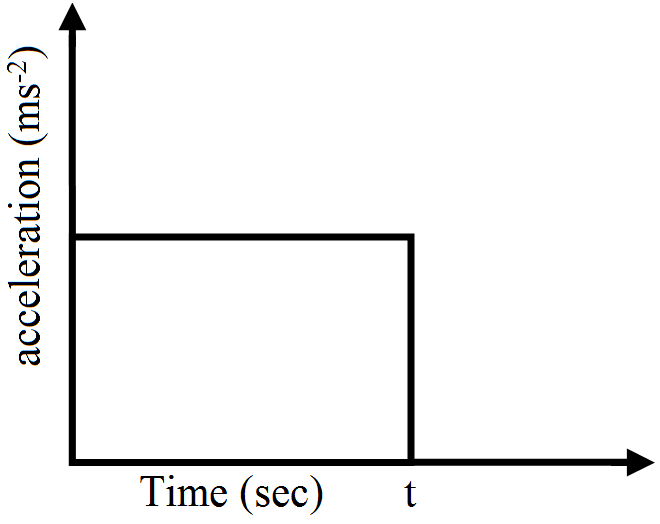
The acceleration-time graph for a body is shown in the figure below. Plot the corresponding velocity-time graph.
Suppose, in certain conditions only those transitions are allowed to hydrogen atoms in which the principal quantum number n changes by $2. (a)$ Find the smallest wavelength emitted by hydrogen. $(b)$ List the wavelength emitted by hydrogen in the visible range $(380\ nm$ to $780\ nm).$