Question
What is the difference between thigmotropism and thigmonasty? Name one plant which exhibits thigmotropism and one plant which exhibits thigmonasty. What behaviour (or responses) of these plants make you think that they exhibit thigmotropism and thigmonasty respectively?
Answer

Thigmotropism
Thimonasty
The directional growth movement of a plant touch of an object is called thigmotropism. Example: Tendrils.
The non-directional movement of a plant part in responce to the touch of an object is called thigmonasty. Example: Mimosapudica.
Tendrils grow towards a stimulus hence it is a directional movement which shows that it is a case of thigmotropism whereas, the folding of leaves in mimosa plant does not depend on the direction of stimulus (touch) which shows that it is an example of thigmonasty.

Need a full question paper?

Generate a complete, print-ready paper with questions like this in minutes — across 16+ boards, with answer keys.

Start Generating Free

Similar questions

How will you connect three resistors of resistances $2Ω, 3Ω$ and $6Ω $ obtain a total n si stance of:
  1. $4 Ω,$
  2. $1Ω$
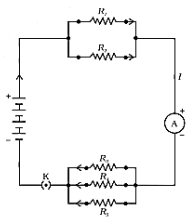
If in figure,$R _1=10 \Omega, R _2=40 \Omega, R _3=30 \Omega, R _4=20 \Omega, R _5=60 \Omega$, and a 12 V battery is connected to the arrangement. Calculate
Image

a. the total resistance in the circuit, and
b. the total current flowing in the circuit.
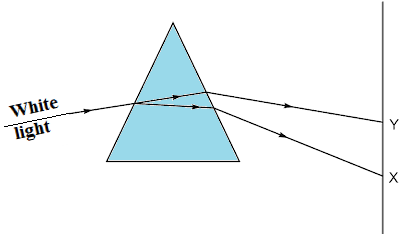
In the figure given alongside, a narrow beam of white light is shown to pass through a triangular glass prism. After passing through the prism, it produces a spectrum YX on the screen:
State the colour seen.
  1. At X, and
  2. At Y​​​​​​​​​​​​

​​​​​​​​​​​​
  1. violet.
  2. Red
  1. ​​​​​​​Why do different colours of white light bend through different angles with respect to the incident beam of light?
A squirrel is in a scary situation. Its body has to prepare for either fighting or running away. State the immediate changes that take place in its body so that the squirrel is able to either fight or run?
A man holds a spherical shaving mirror of radius of curvature 60cm, and focal length 30cm, at a distance of 15cm, from his nose. Find the position of image, and calculate the magnification.
If we cross pure-bred tall (dominant) pea plant with pure-bred dwarf (recessive) pea plant will get pea plants of $F_1$ generation. If we now selfcross the pea plant of $F_1$ generation, then we obtain pea plants of $F_2$ generation.
i. What do the plants of $F_1$ generation look like?
ii. State the ratio of tall plants to dwarf plants in $F_2$ generation.
iii. State the type of plants not found $F_1$ in generation but appeared in $F_2$ generation, mentioning the reason for the same.
With the help of an example, explain how variation leads to evolution.
A substance X, which is an oxide of a group 2 element, is used intensively in the cement industry. This element is present in bones also. On treatment with water it forms a solution which turns red litmus blue. Identify X and also write the chemical reactions involved.
Why is the amount of gas collected in one of the test tubes in Activity 1.7 double of the amount collected in the other? Name this gas.
An old man cannot see objects closer than 1 m from the eye clearly. Name the defect of vision he is suffering from. How can it be corrected? Draw ray diagram for the,
  1. Defect of vision and also.
  2. For its correction.