Question
What is the direction of the electric dipole moment vector quantity?

Answer

From negative to positive charge.

Need a full question paper?

Generate a complete, print-ready paper with questions like this in minutes — across 16+ boards, with answer keys.
Start Generating Free

Similar questions

A wire of resistivity $\rho$ is stretched to double its length. What will be its new resistivity?
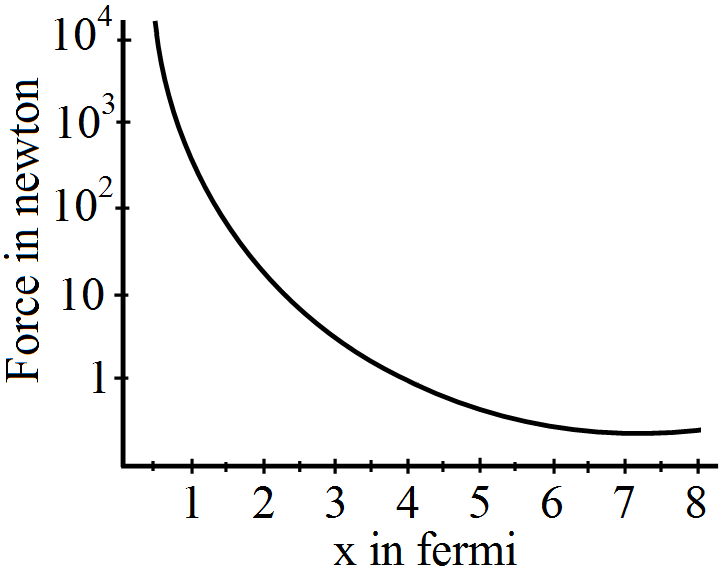
Suppose the magnitude of Nuclear force between two protons varies with the distance between them as shown in figure. Estimate the ratio "Nuclear force/Coulomb force" for:
  1. x = 8fm
  2. x = 4fm
  3. x = 2fm
  4. x = 1fm (1fm = 10-15m).

On a winter day the temperature of the tap water is 20°C whereas the room temperature is 5°C. Water is stored in a tank of capacity 0.5m3 for household use. If it were possible to use the heat liberated by the water to lift a 10kg mass vertically, how high can it be lifted as the water comes to the room temperature? Take g = 10m s-2.
de Broglie wavelength associated with an electron accelerated through a potential difference V $\lambda$ is . What will be its wavelength when the accelerating potential is increased to 4 V?
Calculate the potential at a point located at a distance $9 \times 10^{-2} m$ due to charge $4 \times 10^{-9} C$
A glass of water has an ice cube floating in water. The water level just touches the rim of the glass. will the water overflow when the ice melts? 
Answer the following question:
An electron travelling west to east enters a chamber having a uniform electrostatic field in north to south direction. Specify the direction in which a uniform magnetic field should be set up to prevent the electron from deflecting from its straight line path.
Choose the correct alternative from the clues given at the end of the each statement:
The size of the atom in Thomson’s model is .......... the atomic size in Rutherford’s model. (much greater than/ no different from/ much less than.)
A photosensitive surface emits photoelectrons when red light falls on it. Will the surface emit photoelectrons when blue light is incident on it? Give reason.
The metallic conductor is at temperature $\theta_1.$ The temperature of metallic conductor is increased to $\theta_2.$ How will the product of its resistivity and conductivity change?