MCQ
What is the driving force in a working Electrical Circuit?
  • Voltage Difference
  • B
    Current
  • C
    Temperature difference
  • D
    Chemical Imbalance

Answer

Correct option: A.
Voltage Difference

When a potential difference is applied across a resistor then randomly moving free electrons start to move towards positive terminal due to force applied by electric field generated due to voltage difference. thus a start to Current Flows from High Voltage to Low Voltage.
Voltage is cause and current is effect.

Need a full question paper?

Generate a complete, print-ready paper with questions like this in minutes — across 16+ boards, with answer keys.

Start Generating Free

Similar questions

Two long thin charged rods with charge density $\lambda$ each are placed parallel to each other at a distance $d$ apart. The force per unit length exerted on one rod by the other will be $\left(\right.$ where $\left.k=\frac{1}{4 \pi \varepsilon_0}\right)$
$LED$ is constructed from $Ga-As-P$ semiconducting material. The energy gap of this $LED$ is $1.9\, eV$. Calculate the wavelength of light emitted and its colour.

$\left[ h =6.63 \times 10^{-34} \;Js \right.$ and $\left. c =3 \times 10^{8}\; ms ^{-1}\right]$
A charged particle moves along circular path in a uniform magnetic field in a cyclotron. The kinetic energy of the charged particle increases to $4$ times its initial value. What will be the ratio of new radius to the original radius of circular path of the charged particle
A wire is broken in four equal parts. A packet is formed by keeping the four wires together. The resistance of the packet in comparison to the resistance of the wire will be
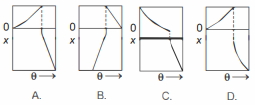
A ray of light originates from inside a glass slab and is incident on its inner surface at an angle $\theta$ as shown below. In this experiment, the location $x$ of the spot where the ray hits the screen is recorded. Which of the following correctly shows the plot of variation of $x$ with the angle $\theta$ ?
Find the value of x in the following nuclear reaction. ${ }_7 \mathrm{~N}^{14}+{ }_2 \mathrm{He}^4 \rightarrow \mathrm{xO}^{17}+{ }_1 \mathrm{H}^1$
A wire has a resistance of $12\, ohm$. It is bent in the form of equilateral triangle. The effective resistance between any two corners of the triangle is
The focal length of a thin biconvex lens is $20 \mathrm{~cm}$. When an object is moved from a distance of $25 \mathrm{~cm}$ in front of it to $50 \mathrm{~cm}$, the magnification of its image changes from $\mathrm{m}_{25}$ to $\mathrm{m}_{50}$. The ratio $\frac{\mathrm{m}_{25}}{\mathrm{~m}_{50}}$ is
Two spherical conductors $A$ and $B$ of radii $1\ mm$ and $2\  mm$ are separated by a distance of $5\ cm$ and are uniformly charged. If the spheres are connected by a conducting wire then in equilibrium condition, the ratio of the magnitude of the electric fields at the surfaces of spheres $A$ and $B$ is
Three concentric conducting spherical shells have radius $ r, 2r$ and $3r$ and $Q_1, Q_2$ and $Q_3$ are final charges respectively. Innermost and outermost shells are already earthed as shown in figure. Choose the wrong statement.