Question
What is the force acting on a charge Q placed in an electric field E?

Answer

$\vec{F}=\overrightarrow{Q E}$

Need a full question paper?

Generate a complete, print-ready paper with questions like this in minutes — across 16+ boards, with answer keys.
Start Generating Free

Similar questions

A long straight current carrying wire passes normally through the centre of circular loop. If the current through the wire increases, will there be an induced emf in the loop? Justify.
In a series LCR circuit, the voltages across an inductor, a capacitor and a resistor are 30 V, 30 V and 60 V respectively. What is the phase difference between the applied voltage and the current in the circuit?
Which device is used as a voltage regulator?
Choose the correct alternative from the clues given at the end of the each statement:
In the ground state of .......... electrons are in stable equilibrium, while in .......... electrons always experience a net force. (Thomson’s model/ Rutherford’s model.)
If an ac circuit, $R=100 \Omega, X_L=400 \Omega$ and $X _{ C }=400 \Omega$, then what is the total impedance of the circuit?
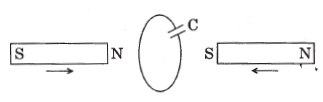
Two bar magnets are quickly moved towards a metallic loop connected across a capacitor 'C' as shown in the figure. Predict the polarity of the capacitor.
Three light sources $A, B$ and $C$ emit equal amount of radiant energy per unit time. The wavelengths emitted by the three sources are $450\ nm, 555\ nm$ and $700\ nm$ respectively. The brightness sensed by an eye for thesources are $X_{A,} X_B$ and $X_C$ respectively. Then,
What is the nature of effective forces in the nucleus?
Identify the part of the electromagnetic spectrum to which the following wavelengths belong$:$
  1. $10^{-1}m$
  2. $10^{-12}m$
The potential difference applied across a given resistance is altered so that heat produced per second increases by a factor of 16. By what factor does the applied pd change?