Question
  1. What is the functional difference between B-cells and T cells
  2. Name the source used to produce hepatitis B vaccine using rDNA technology.

Answer

  1.  
B-cells
T-cells
They produce antibodies, that form part of humoral immunity.
They stimulate B-cells to produce antibodies and they constitute the cell-mediated immunity.
They are not involved in rejecting organ transplants.
They are responsible for rejecting organ transplants.
  1. Yeast cells.

Need a full question paper?

Generate a complete, print-ready paper with questions like this in minutes — across 16+ boards, with answer keys.
Start Generating Free

Similar questions

Differentiate between homology and analogy. Give one example of each.
A student on a school trip started sneezing and wheezing soon after reaching the hill station for no explained reasons. But, on return to the plains the symptoms disappeared. What is such a response called? How does the body produce it?
Define the term addiction. Name some drugs which are normally used as medicines but are often abused.
Define the following terms and give one example for each:
a. Commensalism
b. Parasitism
c. Camouflage
d. Mutualism
e. Interspecific competition
During a school trip to 'Rohtang Pass', one of your classmate suddenly developed 'altitude sickness'. But, he/she recovered after some time.
  1. Mention one symptom to diagnose the sickness.
  2. What caused the sickness?
(i) EcoRI has played a very important role in recombinant DNA technology.
(a) Explain the naming convention of Eco RI.
(b) Write the name of the recognition site and cleavage site of this restriction enzyme.
(ii) What is the longitudinal extension of DNA produced by these restriction enzymes called? Describe their role in the formation of r-DNA.
Name the source of streptokinase. How does this bioactive molecule function in our body?
Mendel crossed plants that breed true for yellow seeds with plants that breed true for green seeds. All seeds in F-generation were yellow. Work out the inheritance involved in this cross by using symbols for each traits and state which trait was dominant?
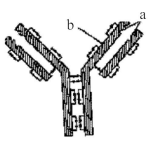
(i) What is shown in the attached diagram?
(ii) Write the names of the parts named 'a' and ‘b’.
(iii) Name of the cell type that produces this molecule.
Image
What does 'Hind' and 'III' refer to in the enzyme Hind III?