MCQ
What is the general electronic configuration for $2^{nd}$ row transition series
  • A
    $[Ne]3{d^{1 - 10}},4{s^2}$
  • B
    $[Ar]3{d^{1 - 10}},4{s^{1 - 2}}$
  • $[Kr]4{d^{1 - 10}},\,\,5{s^{1 - 2}}$
  • D
    $[Xe]5{d^{1 - 10}},\,\,5{s^{1 - 2}}$

Answer

Correct option: C.
$[Kr]4{d^{1 - 10}},\,\,5{s^{1 - 2}}$
c
The general electronic configuration for $2nd$ row transition series is $[ Kr ] 4 d ^{1-10} 5 s ^{1-2}$

Need a full question paper?

Generate a complete, print-ready paper with questions like this in minutes — across 16+ boards, with answer keys.
Start Generating Free

Similar questions

The reduction of which of the following compound would yield secondary amine?
In order to prepare a 1° amine from an alkyl halide with simultaneous addition of one CH2 group in the carbon chain, the reagent used as source of nitrogen is ___________.


Acetanilide on nitration followed by alkaline hydrolysis mainly gives-
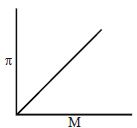
A graph of osmotic pressure $(\pi)$ vs molarity $(M)$ of aqueous solution of $NaCl$ at room  temperature is given below. The slope of the line represents :-
The standard reduction potentials at $298\,K$for the following half reactions are given against each

$Zn^{2 + }(aq.) + 2e⇔  Zn(s)$; $→$  $  -0.762$

$Cr^{3 + }(aq) + 3e  ⇔ Cr(s)$;  $→$    $-0.740$

$2H^ +(aq) + 2e⇔  {H_2}(g)$; $→$    $0.00$

$Fe^{3+}(aq) + e  ⇔ Fe^{2+}(aq)$; $→$  $0.770$

Which is the strongest reducing agent
Decomposition of $H_2O$ follows a first order reaction. In fifty minutes the concentration of $H_2O_2$ decreases from $0.5$ to $0.125\,\min$ one such decomposition. When the concentration of $H_2O_2$ reaches $0.05\, M,$ the rate of formation of $O_2$ will be :
In which of the following reaction product does not contain 'Peroxy' linkage?
100 mL of liquid A and 25 mL of liquid B are mixed to formal solution of volume 125 mL. Then the solution is___________.
The rate of a gaseous reaction is given by the expression $K\,[A]\,[B]$. If the volume of the reaction vessel is suddenly reduced to $1/4^{th} $ of the initial volume, the reaction rate relating to original rate will be
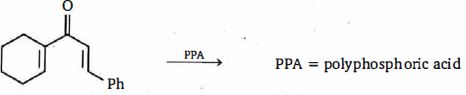
Product obtained in the following transformation is