MCQ
What is the maximum value of $(x)$ ?
  • A
    $1$
  • $2$
  • C
    $3$
  • D
    $4$

Answer

Correct option: B.
$2$
b
$(b)\, (x = 2) HIO_4$ will not cleave ether

Need a full question paper?

Generate a complete, print-ready paper with questions like this in minutes — across 16+ boards, with answer keys.

Start Generating Free

Similar questions

Assertion : The molecular weight of acetic acid determined by depression in freezing point method in benzene and water was found to be different.

Reason : Water is polar and benzene is nonpolar.

Select the correct statement 
The complete combustion of $0.492\, g$ of an organic compound containing $'C', 'H'$ and $'O'$ gives $0.793\, g$ of $CO _{2}$ and $0.442\,g$ of $H _{2} O$. The percentage of oxygen composition in the organic compound is .... (nearest integer)
The given data are for the reaction :

$2NO(g) + Cl_2(g) \to 2NOCl(g)$ at $298\, K$

$[Cl_2]$                $[NO]$                       Rate $(mol\, L^{-1} \sec^{-1})$

$I$    $0.05\, M$       $0.05\,M$                           $1 \times 10^{-3}$

$II$   $0.15\, M$      $0.05\,M$                           $3 \times 10^{-3}$

$III$  $0.05\, M$      $0.15\,M$                           $9 \times 10^{-3}$

The rate law for the reaction is
Which of the following is not a colligative property [
Which metal does not give the following reaction $M +$  water or steam $ \to $oxide $ + H$ $\downarrow$
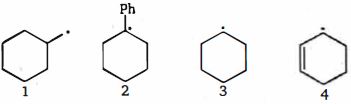
Rank the following alkyl radicals in order of increasing stability (least $< < <$ most).
Which of the following is paramagnetic ?
Reaction of an inorganic sulphite $X$ with dilute $H _{2} SO _{4}$ generates compound $Y$. Reaction of $Y$ with $NaOH$ gives $X$. Further, the reaction of $X$ with $Y$ and water affords compound $Z$. $Y$ and $Z ,$ respectively, are:
Which is the most volatile compound