Question
What is the net magnetic flux through a closed surface?

Answer

  1. Zero
Explanation:
Gauss’s law indicates that there are no sources or sinks of the magnetic field inside a closed surface. A “closed surface” is a surface that completely encloses a volume with no holes. Therefore, the net magnetic flux through a closed surface is zero.

Need a full question paper?

Generate a complete, print-ready paper with questions like this in minutes — across 16+ boards, with answer keys.
Start Generating Free

Similar questions

de$-$Broglie wavelength of a body of mass $1 \ kg$ moving with velocity of $2000\ m/s$ is
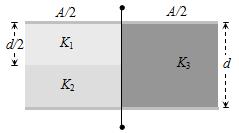
In the figure a capacitor is filled with dielectrics. The resultant capacitance is
Second law of Kirchhoff depends on the principle of conservation of:
The output of OR gate of two input terminals will be zero only when :
Tesla is the unit of(a) Electric flux(b) Magnetic flux(c) Electric field(d) Magnetic field
       
The kinetic energy needed to project a body of mass m from the earth's surface to infinity is:
  1. $\frac{1}{4}\text{mgR}$
  2. $\frac{1}{2}\text{mgR}$
  3. $\text{mgR}$
  4. $2\text{mgR}$
An antenna is a device (a) That converts electromagnetic energy into radio frequency signal(b) That converts radio frequency signal into electromagnetic energy(c) That converts guided electromagnetic waves into free space electromagnetic waves and vice-versa(d) None of these


Two cells of equal $e.m.f.$ and of internal resistances $\mathrm{r}_1$ and $r_2\left(r_1>r_2\right)$ are connected in series. On connecting this combination to an external resistance $R ,$ it is observed that the potential difference across the first cell becomes zero. The value of $R$ will be
The Avogadro's number is $6 \times 10^{23}$ per $gm$ mole and electronic charge is $1.6 \times 10^{-19} \mathrm{C}$ The Faraday's number is
For measurement of potential difference, potentiometer is preferred in comparison to voltmeter because(a) Potentiometer is more sensitive than voltmeter(b) The resistance of potentiometer is less than voltmeter(c) Potentiometer is cheaper than voltmeter(d) Potentiometer does not take current from the circuit