Question
What is the order of potential difference built up by the Van de Graff generator?

Answer

  1. Potential difference of the order of several million volts.
Explanation:
A Van de Graff generator, by means of a moving belt and suitable brushes, transfers charge continuously to a large spherical conducting shell. As a result, a potential difference of the order of several million volts is built up and this can be used for accelerating charged particles.

Need a full question paper?

Generate a complete, print-ready paper with questions like this in minutes — across 16+ boards, with answer keys.
Start Generating Free

Similar questions

Infinite charges of magnitude $q$ each are lying at $x =1, 2, 4, 8...$ meter on $X-$axis. The value of intensity of electric field at point $x = 0$ due to these charges will be
Rutherford’s atomic model was unstable because:
One ampere is equal to :
An $AC$ source producing emf $\epsilon=\epsilon_{0}\Big[\cos\big(100\pi\text{s}^{-1}\big)\text{t}+\cos\big(500\pi\text{s}^{-1}\big)\text{t}\Big]$ is connected in series with a capacitor and a resistor. The steady-state current in the circuit is found to be $\text{i}=\text{i}_1\cos\Big[\big(100\pi\text{s}^{-1}\big)\text{t}+\phi_1\Big]+\text{i}_2\cos\Big[\big(500\pi\text{s}^{-1}\big)\text{t}+\phi_2\Big].$
Two identical thin rings each of radius $R$ meters are coaxially placed at a distance $R$ meters apart. If $Q_1$ coulomb and $Q_2$ coulomb are respectively the charges uniformly spread on the two rings, the work done in moving a charge qfrom the centre of one ring to that of other is
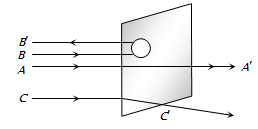
A beam of fast moving alpha particles were directed towards a thin film of gold. The parts $A^{\prime}, B^{\prime}$ and $C^{\prime}$ of the transmitted and reflected beams corresponding to the incident parts $A, B$ and $C$ of the beam, are shown in the adjoining diagram. The number of alpha particles in
A conducting resistor is joined with a battery. If the temperature of the conductor is changed with the cooling process, then the magnitude of current flowing:
In a thermocouple, the temperature that does not depend on the temperature of the cold junction is called(a) Neutral temperature(b) Temperature of inversion(c) Both the above(d) None of the above
   
   
Three charges each of magnitude $q$ are placed at the corners of an equilateral triangle, the electrostatic force on the charge placed at the center is $($each side of triangle is $L)$
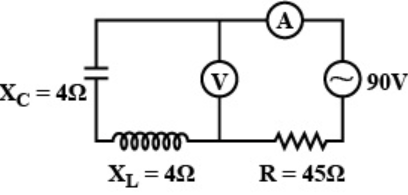
The reading of voltmeter and ammeter in the following figure will respectively be:
Image