MCQ
What is the packet of energy called
  • A
    Electron
  • Photon
  • C
    Positron
  • D
    Proton

Answer

Correct option: B.
Photon
b
(b) According to quantum theory of radiation, a hot body emits radiant energy not continuously but discontinuously in the form of small packets of energy called quanta or photons.

Need a full question paper?

Generate a complete, print-ready paper with questions like this in minutes — across 16+ boards, with answer keys.

Start Generating Free

Similar questions

The tendency of $BF_3, BCl_3$ and $BBr_3$ to behave as Lewis acid decreases in the sequence
An electron in a hydrogen atom in its ground state absorbs $2$ times as much energy as the minimum required for it to escape from the atom. The kinetic energy of the emitted electron is ............ $\mathrm{eV}$
Propan $-1-$ ol can be prepared from propene by
${K_4}[Fe{(CN)_6}] + \,{M^{x + }}(aq.) \to \mathop {{M_4}{{[Fe{{(CN)}_6}]}_x}}\limits_{Coloured\,\,precipirate} \, \downarrow $

Which of the following cation does not respond to the above reaction ?

Which of the following statements is incorrect for salt bridge?
Which of the following compounds show colour due to $d-d$ transition?
An ideal gas is expanded from $\left(p_1, V_1, T_1\right)$ to $\left(p_2, V_2, T_2\right)$ under different conditions. The correct statement(s) among the following is(are)

[$A$] The work done on the gas is maximum when it is compressed irreversibly from ( $\mathrm{p}_2, \mathrm{~V}_2$ ) to ( $\mathrm{p}_1, \mathrm{~V}_1$ ) against constant pressure $\mathrm{pl}_1$

[$B$] The work done by the gas is less when it is expanded reversibly from $V_1$ to $V_2$ under adiabatic conditions as compared to that when expanded reversibly from $V_1$ to $V_2$ under isothermal conditions

[$C$] The change in internal energy of the gas is ($i$) zero, if it is expanded reversibly with $T_1=T_2$, and ($ii$) positive, if it is expanded reversibly under adiabatic conditions with $T_1 \neq T_2$

[$D$] If the expansion is carried out freely, it is simultaneously both isothermal as well as adiabatic
Lithium shows diagonal relationship with
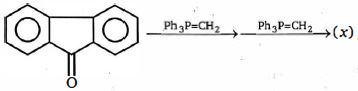
Product $(x)$ is
In which of the following, a salt of the type $KMO_2$ is obtained?