Question
What is the phase difference between any two points located on a wave front?

Answer

Zero.

Need a full question paper?

Generate a complete, print-ready paper with questions like this in minutes — across 16+ boards, with answer keys.
Start Generating Free

Similar questions

What is the magnification in this case?
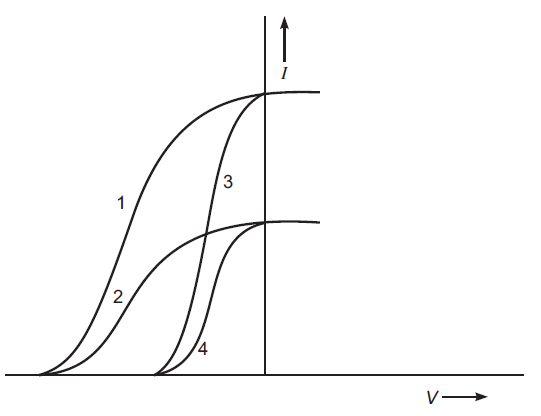
The given graph shows the variation of photo-electric current (I) versus applied voltage (V) for two different photosensitive materials and for two different intensities of the incident radiation. Identify the pairs of curves that correspond to different materials but same intensity radiation.

What is the basic reason of refraction?
"For any charge configuration, equipotential surface through a point is normal to the electric field." Justify.
Differentiate between conduction current and displacement current.
A rubber balloon is given a charge Q distributed uniformly over its surface. Is the field inside the balloon zero everywhere if the balloon does not have a spherical surface?
The coercive force for a certain permanent magnet is 4.0 × 10⁴A/m. Thia magnet is placed inside a long solenoid of 40 turns/cm and a current is passed in the solenoid to demagnetise it completely. Find the current.
On what factors is induced current in a coil depends?
A parallel plate capacitor is filled by a dielectric whose relative permittivity varies with the applied voltage (U) as $\in=\alpha\text{U}$ where $\alpha=2\text{V}^{-1}$. A similar capacitor with no dielectric is charged to U0 = 78V. It is then connected to the uncharged capacitor with the dielectric. Find the final voltage on the capacitors.
Mark the correct options.
  1. The luminous efficiency of a monochromatic source is always greater than that of a white light source of same power.
  2. The luminous efficiency of a monochromatic source of wavelength 555nm is always greater than that of a white light source of same power.
  3. The illuminating power of a monochromatic source of wavelength 555nm is always greater than that of a white light source of same power.
  4. The illuminating power of a monochromatic source is always greater than that of a white light source of same power.