MCQ
What is the phase difference between two successive crests in the wave
  • A
    $\pi$
  • B
    $\pi /2$
  • $2 \pi$
  • D
    $4 \pi$

Answer

Correct option: C.
$2 \pi$
c
(c) Since distance between two consecutive crests is $\lambda$, so

$\phi = \frac{{2\pi }}{\lambda } \times \lambda = 2\pi .$

Need a full question paper?

Generate a complete, print-ready paper with questions like this in minutes — across 16+ boards, with answer keys.

Start Generating Free

Similar questions

A box contains a mixture of ${H_2}$ and $He$ gases. Which of the following statements are corrects
In which of the following process, convection does not take place primarily
A source and listener are both moving towards each other with speed $v/10$, where $v$ is the speed of sound. If the frequency of the note emitted by the source is $f$, the frequency heard by the listener would be nearly
The function $sin^2\,(\omega t)$ represents
A uniform plank of Young’s modulus $Y $ is moved over a smooth horizontal surface by a constant horizontal force $F.$ The area of cross section of the plank is $A.$ The compressive strain on the plank in the direction of the force is
In figure, two blocks $M$ and $m$ are tied together with an inextensible and light string. The mass $M$ is placed on a rough horizontal surface with coefficient of friction $\mu$ and the mass $m$ is hanging vertically against a smooth vertical wall. The pulley is frictionless. When the downward acceleration of the elevator becomes equal to $g$, then
A string vibrates according to the equation $y = 5\sin \,\left( {\frac{{2\pi x}}{3}} \right)\,\,\cos \,20\,\pi t$, where $x$ and $y$ are in $cm$ and $t$ in sec. The distance between two adjacent nodes is .... $cm$
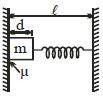
A block of mass $m$ is pressed against a vertical surface by a spring of unstretched length $l$ . If the coefficient of friction between the block and the surface is $\mu $. Choose the correct statement.
Two waves ${y_1} = {A_1}\sin (\omega t - {\beta _1})$, ${y_2} = {A_2}\sin (\omega t - {\beta _2})$ Superimpose to form a resultant wave whose amplitude is
“Heat cannot by itself flow from a body at lower temperature to a body at higher temperature” is a statement or consequence of