MCQ
What is the relationship between the two structures shown ?
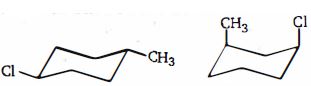
- ✓Constitutional isomers
- BStereoisomers
- CDifferent drawing of the same conformation of the same compound
- DDifferent conformation of the same compound
Generate a complete, print-ready paper with questions like this in minutes — across 16+ boards, with answer keys.
$CH_3-CH=CH-CH_2-C\equiv CH$
|
List $I$ (Molecule Species) |
List $I$ ( Property Shape ) |
| $A$ $\mathrm{SO}_2 \mathrm{Cl}_2$ | $I$ Paramagnetic |
| $B$ $NO$ | $II$ Diamagnetic |
| $C$ $\mathrm{NO}_2^{-}$ | $III$ Tetrahedral |
| $D$ $\mathrm{I}_3^{-}$ | $IV$ Linear |
Choose the correct answer from the options given below :
$\mathrm{H}_2(\mathrm{~g})+\mathrm{I}_2(\mathrm{~g}) \rightleftharpoons 2 \mathrm{HI}(\mathrm{g})$, the $\mathrm{K}_{\mathrm{p}}$ for the process is $\mathrm{x} \times 10^{-1} \cdot \mathrm{x}=$ $\qquad$
[Given : $\mathrm{R}=0.082 \mathrm{~L} \mathrm{~atm} \mathrm{~K}^{-1} \mathrm{~mol}^{-1}$ ]
A. $1\text{s}^2\ 2\text{s}^2\ 2\text{p}^6$ B. $1\text{s}^2\ 2\text{s}^2\ 2\text{p}^4$ C.$1\text{s}^2\ 2\text{s}^2\ 2\text{p}^6\ 3\text{s}^1$ D.$1\text{s}^2\ 2\text{s}^2\ 2\text{p}^5$
Which of the following is the correct order of increasing tendency to gain electron: