MCQ
What is the restoring force proportional to in simple harmonic motion?
  • A
    Velocity
  • Displacement from mean position
  • C
    Mass
  • D
    Angular acceleration

Answer

Correct option: B.
Displacement from mean position
(B)

Need a full question paper?

Generate a complete, print-ready paper with questions like this in minutes — across 16+ boards, with answer keys.
Start Generating Free

Similar questions

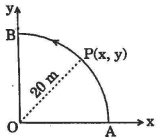
A point $P$ moves in counter-clockwise direction on a circular path as shown in the figure. The movement of '$P$' is such that it sweeps out a length  $s = t^3+5$, where s is in metres and $t$ is in seconds. The radius of the path is $20\ m$. The acceleration of '$P$' when $t = 2\ s$ is nearly ..........  $m/s^2$
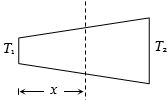
Radius of a conductor increases uniformly from left end to right end as shown in fig.Material of the conductor is isotropic and its curved surface is thermally isolated from surrounding. Its ends are maintained at temperatures $T_1$ and $T_2$ ($T_1$ > $T_2$): If, in steady state, heat flow rate is equal to $H$ , then which of the following graphs is correct
If $m$ is the mass, $\theta$ is temperature and $'a\ '$ is specific heat, then thermal capacity $K$ is given by:
A tunnel is dug in the earth across one of its diameter. Two masses $‘m’\,\& \,‘2m’$ are dropped from the ends of the tunnel. The masses collide and stick to each other and perform $S.H.M.$ Then amplitude of $S.H.M.$ will be : [$R =$ radius of the earth]
The value of $\gamma\left(=\frac{\mathrm{C}_{\mathrm{p}}}{\mathrm{C}_{\mathrm{v}}}\right),$ for hydrogen, hellium and another ideal diatomic gas $X$(whose molecules are not rigid but have an additional vibrational mode), are respectively equal to 
The collisions of the molecules of an ideal gas are:
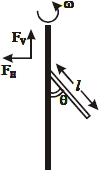
A uniform rod of length $'l'$ is pivoted at one of its ends on a vertical shaft of negligible radius When the shaft rotates at angular speed $\omega$ the rod makes an angle $\theta$ with it (see figure). To find $\theta$ equate the rate of change of angular momentum (direction going into the paper ) $\frac{ m \ell^{2}}{12} \omega^{2} \sin \theta \cos \theta$ about the centre of mass $(CM)$ to the torque provided by the horizontal and vertical forces $F_{H}$ and $F_{V}$ about the CM. The value of $\theta$ is then such that:
If two vectors $\vec{P}=\hat{i}+2 m \hat{j}+m \hat{k}$ and $\vec{Q}=4 \hat{i}-2 \hat{j}+ mk$ are perpendicular to each other. Then, the value of $m$ will be :
When the speed of a body is doubled, its kinetic energy becomes:
The equation of state of a real gas is given by $\left(\mathrm{P}+\frac{\mathrm{a}}{\mathrm{V}^2}\right)(\mathrm{V}-\mathrm{b})=\mathrm{RT}$, where $\mathrm{P}, \mathrm{V}$ and $\mathrm{T}$ are pressure. volume and temperature respectively and $R$ is the universal gas constant. The dimensions of $\frac{a}{b^2}$ is similar to that of :