MCQ
What is the restoring force proportional to in simple harmonic motion?
  • A
    Velocity
  • Displacement from mean position
  • C
    Mass
  • D
    Angular acceleration

Answer

Correct option: B.
Displacement from mean position
(B)

Need a full question paper?

Generate a complete, print-ready paper with questions like this in minutes — across 16+ boards, with answer keys.
Start Generating Free

Similar questions

A rocket is fired vertically frorn the earth with an acceleration of  $2\,g,$  where $g$  is the gravitational acceleration. On an inclined plane inside the rocket, making an angle $\theta $ with the horizontal, a point object of mass $m$ is kept. The minimum coefficient of friction $\mu _{min}$  between the mass and the inclined surface such that the mass does not move is
A body takes $T$ minutes to cool from ${62^o}C$ to ${61^o}C$ when the surrounding temperature is ${30^o}C$. The time taken by the body to cool from ${70^o}$ to $({A_1}\,{\rm{and }}{A_{\rm{2}}})$ is
The energy of a given sample of an ideal gas depends only on its:
A particle of mass $m_1$ is moving with a velocity $v_1$ and another particle of mass $m_2$ is moving with a velocity $v_2$ . Both of them have the same momentum but their different kinetic energies are $E_1$ and $E_2$ respectively. If $m_1 > m_2$ then
A student measuring the diameter of a pencil of circular cross-section with the help of a vernier scale records the following four readings $5.50\, mm , 5.55\, mm ,$$ 5.45\, mm ; 5.65\, mm .$ The average of these four readings is $5.5375\, mm$ and the standard deviation of the data is $0.07395\, mm .$ The average diameter of the pencil should therefore be recorded as
In a stationary wave, all particles are
Two satellites $A$ and $B$ go round a planet $ P$ in circular orbits having radii $4R$ and $R$ respectively. If the speed of the satellite $A$ is $3V$, the speed of the satellite $B$ will be ........ $V$
Force $(F)$ and density $(d)$ are related as $F\, = \,\frac{\alpha }{{\beta \, + \,\sqrt d }}$ then dimension of $\alpha $ are
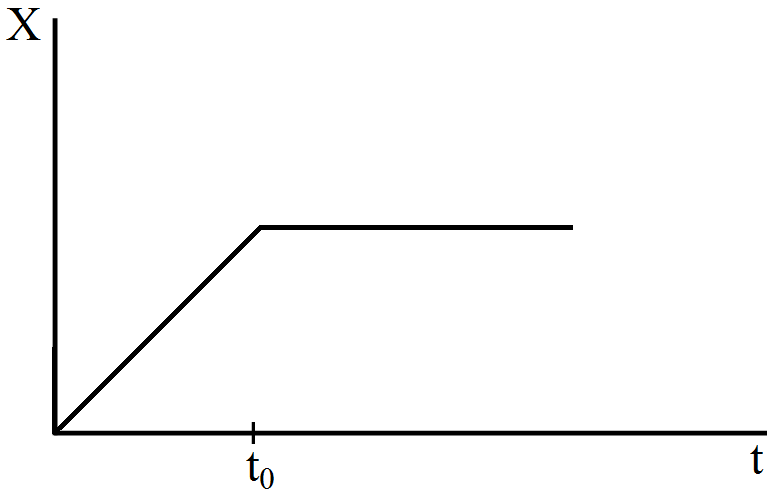
Figure shows the displacement-time graph of a particle moving on the X-axis.

Two cars are moving on two perpendicular roads towards a crossing with uniform speeds of $72\; km/hr$ and $36\; km/hr$. If first car blows horn of frequency $280\; Hz,$ then the frequency of horn heard by the driver of second car when line joining the cars make $45^o$ angle with the roads; will be .... $Hz$