Question
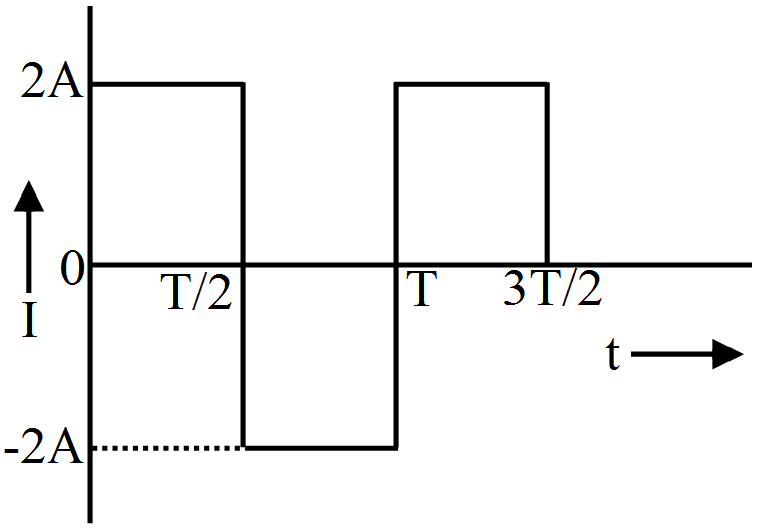
What is the rms value of alternating current shown in figure?

Answer

$(\text{I}^2)_{\text{mean}}=\frac{\int\limits^{\text{T}}_{0}\text{I}^2\text{dt}}{\int\text{dt}}=\frac{\int\limits^{\frac{\text{T}}{2}}_0(2)^2\text{dt}+\int\limits^{\text{T}}_{\frac{\text{T}}{2}}(-2)^2\text{dt}}{\text{T}}=\frac{\int\limits^{\text{T}}_04\text{dt}}{\text{T}}=4$
$\text{I}_{\text{rms}}=\sqrt{4}=2\text{A}$

Need a full question paper?

Generate a complete, print-ready paper with questions like this in minutes — across 16+ boards, with answer keys.
Start Generating Free

Similar questions

A uranium-238 nucleus, initially at rest, emits an alpha particle with a speed of $1.4 x 10^7 \ m/s$. Calculate the recoil speed of the residual nucleus thorium-234. Assume that the mass of a nucleus is proportional to the mass number.
The pressure of a gas changes linearly with volume from 10kPa, 200cc to 50kPa, 50cc.
  1. Calculate the work done by the gas.
  2. If no heat is supplied or extracted from the gas, what is the change in the internal energy of the gas?
Find the potential energy of a system made up of three point charges.
Write a short note on Infrared waves.
  1. Write two main observations of photoelectric effect experiment which could only be explained by Einstein’s photoelectric equation.
  2. Draw a graph showing variation of photocurrent with the anode potential of a photocell.
Give the SI unit and definition of electric charge and also write down the smaller unit.
Illustrate by drawing the helical motion of a charged particle in a uniform magnetic field and derive the equations of pitch and radius of helix. $\#\#\#$ Discuss the path of motion of a charged particle entering with velocity at angle $\theta$ with uniform magnetic field. $($where $\theta \neq 0, \frac{\pi}{2}, \pi )$
Two bar magnets are placed close to each other with their opposite poles facing each other. In absence of other force the magnets are pulled towards each other and their kinetic energy increases. Does it contradict our earher knowledge that magnetic forces cannot do any work and hence cannot increase kinetic energy of a system?
  1. The mass of a nucleus in its ground state is always less than the total mass of its constituents - neutrons and protons. Explain.
  2. Plot a graph showing the variation of potential energy of a pair of nucleons as a function of their separation.
Let $\vec{\text{a}}=2\vec{\text{i}}+3\vec{\text{j}}+4\vec{\text{k}}$ and $\vec{\text{b}}=3\vec{\text{i}}+4\vec{\text{j}}+5\vec{\text{k}}.$ Find the angle between them.