Question
What is the smallest positive integer n for which $(1+\text{i})^{2\text{n}}=(1-\text{i})^{2\text{n}} \ ?$

Answer

$(1+\text{i})^{2\text{n}}=(1-\text{i})^{2\text{n}}$
$\Rightarrow\Big(\frac{1+\text{i}}{1-\text{i}}\Big)^{2\text{n}}=1$
$\Rightarrow\Big(\frac{(1+\text{i})(1+\text{i})}{(1-\text{i})(1+\text{i})}\Big)^{2\text{n}}=1$ [Rationalizing the denominator]
$\Rightarrow\Big(\frac{1+2\text{i}-1}{1+1}\Big)^{2\text{n}}=1$
$\Rightarrow\Big(\frac{2\text{i}}{2}\Big)^{2\text{n}}=1$
$\Rightarrow\text{i}^{2\text{n}}=1$
$\therefore\text{n}=2$

Need a full question paper?

Generate a complete, print-ready paper with questions like this in minutes — across 16+ boards, with answer keys.

Start Generating Free

Similar questions

Find the standard deviation for the following data:
x
3
8
13
18
23
f
7
10
15
10
6
Evaluate the following limit:
$\lim\limits_{\text{x}\rightarrow{{\pi}}}\frac{1+\cos\text{x}}{\tan^2\text{ x}}$
Calculate the mean deviation about the median of the following observation:
38, 70, 48, 34, 63, 42, 55, 44, 53, 47
For the function $\text{f}(\text{x})=\frac{\text{x}^{100}}{100}+\frac{\text{x}^{99}}{99}+\dots+\frac{\text{x}^2}{2}+\text{x}+1.$Prove that $\text{f}'(1)=100\text{f}'(0).$
One of the four persons John, Rita, Aslam or Gurpreet will be promoted next month. Consequently the sample space consists of four elementary outcomes S = {John promoted, Rita promoted, Aslam promoted, Gurpreet promoted} You are told that the chances of John’s promotion is same as that of Gurpreet, Rita’s chances of promotion are twice as likely as Johns. Aslam’s chances are four times that of John:
  1. Determine P(John promoted)

P(Rita promoted)
P(Aslam promoted)
P(Gurpreet promoted)
  1. If A = {John promoted or Gurpreet promoted}, find P(A).
Prove that:
$\frac{1}{\sin\text{(x}-\text{b})\sin\text{(x}-\text{b)}}=\frac{\cot\text{(x}-\text{b)}-\cot\text{(x}-\text{b)}}{\sin\text{(a}-\text{b)}}$
Four candidates A, B, C, D have applied for the assignment to coach a school cricket team. If A is twice as likely to be selected as B, and B and C are given about the same chance of being selected, while C is twice as likely to be selected as D, what are the probabilities that:
  1. C will be selected?
  2. A will not be selected?
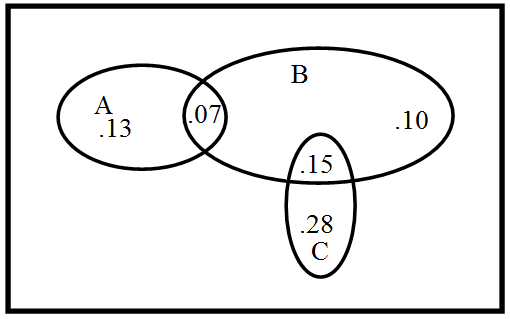
The accompanying Venn diagram shows three events, A, B, and C, and also the probabilities of the various intersections $($for instance, $\text{P}(\text{A}\cap\text{B})=.07)$ Determine:
  1. $\text{P(A)}$
  2. $\text{P}(\text{B}\cap\bar{\text{C}})$
  3. $\text{P(A}\cup\text{B})$
  4. $\text{P(A}\cap\bar{\text{B}})$
  5. $\text{P(B}\cap\text{C})$
  6. Probability of exactly one of the three occurs.
If arg(z - 1) = arg(z + 3i) then find x - 1, y where z = x + iy.
An experiment involves rolling a pair of dice and recording the numbers that come up. Describe the following events:
A: the sum is greater than 8, B: 2 occurs on either die.
C: the sum is at least 7 and a multiple of 3
which pairs of these events are mutually exclusive?