Question
What is the temperature at which all the gas molecule become immobile?

Answer

According to the molecular kinetic theory of gas, the average kinetic energy per molecule of gas is directly proportional to the absolute temperature, that mean
$\frac{1}{2} mC _{ rms }^2 \propto T$
The mean square velocity $\left( C _{ rms }\right)$ of the gas will be zero if absolute temeprature $T =0$.
Therefore, at absolute zero temperature all the molecules become motionless.

Need a full question paper?

Generate a complete, print-ready paper with questions like this in minutes — across 16+ boards, with answer keys.
Start Generating Free

Similar questions

Two cylinders A and B of radii r and 2r are soldered co-axially. The free end of A is clamped and the free end of B is twisted by an angle $\phi.$ Find twist at the junction taking the material of two cylinders to be same and of equal length.
At what speed the volume of an object shrinks to half its rest value?
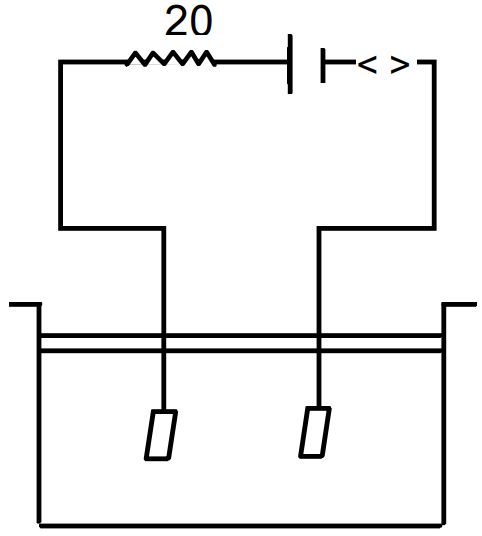
Figure shows an electrolyte of AgCl through which a current is passed. It is observed that 2.68g of silver is deposited in 10 minutes on the cathode. Find the heat developed in the $20\Omega$ resistor during this period. Atomic weight of silver is 107.9g/mole.
A parallel-plate capacitor is filled with a dielectric material of resistivity ρ and dielectric constant K. The capacitor is charged and disconnected from the charging source. The capacitor is slowly discharged through the dielectric. Show that the time constant of the discharge is independent of all geometrical parameters like the plate area or separation between the plates. Find this time constant.
Explain why Water on a clean glass surface tends to spread out while mercury on the same surface tends to form drops. (Put differently, water wets glass while mercury does not.)
Give any two examples to explain Newton's third law.
A mass $M_1$ revolves around another mass $M_2$ in a path of radius r, what is the angular momentum associated with $M_1$?
Determine the force required to double the length of a steel wire of area of cross-section $5 \times 10^{-5}m^2$. Young's modulus of steel = $2 \times 10^{11}Nm^{-2}$.
On a wire whose diameter is 0.4 cm, a weight of 25 kg is suspended due to this, the length of 50 cm wire becomes 51 cm then find the Young's Modulus of elasticity?
A transverse harmonic wave on a string is described by
$\text{y}(\text{x, t})=3.0\sin\big(36\text{t}+0.018\text{x}+\frac{\pi}{4}\big)$
where x and y are in cm and t in s. The positive direction of x is from left to right.
What is the least distance between two successive crests in the wave?