MCQ
What is the total work done on moving a test charge on an equipotential surface?
  • A
    Maximum
  • B
    Minimum
  • C
    Constant
  • Zero

Answer

Correct option: D.
Zero

The potential difference between any two points on an equipotential surface is zero.
Work done $=$ Test charge $\times$ potential difference$(0)$

Need a full question paper?

Generate a complete, print-ready paper with questions like this in minutes — across 16+ boards, with answer keys.
Start Generating Free

Similar questions

An inductor coil stores $U$ energy when $i$ current is passed through it and dissipates energy at the rate of $P$. The time constant of the circuit, when this coil is connected across a battery of zero internal resistance is
$X$-rays of wavelength $22 \,pm$ are scattered from a carbon target at an angle of $85^{\circ}$ to the incident beam. The Compton shift for $X$-rays is ......... $pm$
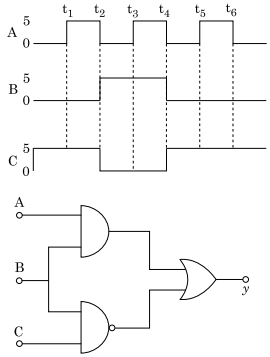
For the given circuit, the input digital signals are applied at the terminals $\mathrm{A}, \mathrm{B}$ and $\mathrm{C}$. What would be the output at the terminal $y$ ?
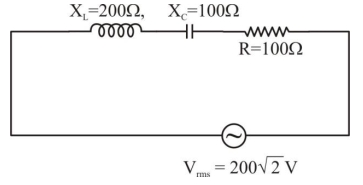
In the given circuit, rms value of current $\left( I _{ rms }\right)$ through the resistor $R$ is :$..........\,A$
Certain radioactive substance reduces to $25\%$ of its value in $16\ days$. Its half-life is .......... $days$
Assertion : There is no current in the metals in the absence of electric field.
Reason : Motion of free electron are randomly.
The number of photons emitted by a $10\,watt$ bulb in $10\,second,$ if wavelength of light is $1000\,\,\mathop A\limits^o ,$ is
In the case of constants $\alpha$ and $\beta$ of a transistor
$(1)$  The product of a volt and a coulomb is a joule.

$(2)$  The product of a volt and an ampere is a joule/second.

$(3)$  The product of volt and watt is horse power.

$(4)$  Watt-hour can be measured in terms of electron volt.

State if
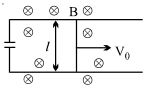
Two infinitely long conducting parallel rails are connected through a capacitor $C$ as shown in the figure. $A$ conductor of length $l$ is moved with constant speed $v_0$.Which of the following graph truly depicts the variation of current through the conductor with time ?