MCQ
What is the use of a Van de Graff generator?
  • A
    Van de Graff generator is used to create a large amount of current.
  • B
    Van de Graff generator is used to create a small amount of voltage.
  • Van de Graff generator is used to create a large amount of static electricity.
  • D
    Van de Graff generator is used to create a small amount of resistance.
Answer

Correct option: C.
Van de Graff generator is used to create a large amount of static electricity.

Van de Graff generator is used to create a large amount of static electricity. A Van de Graff generator uses static electricity and a moving belt to charge a large metal sphere to a very high voltage. As the belt moves, electrons move from the rubber belt to the silicon roller, causing the belt to become positively charged and the roller to become negatively charged. As a result, it builds up positive charge.

Need a full question paper?

Generate a complete, print-ready paper with questions like this in minutes — across 16+ boards, with answer keys.

Start Generating Free

Similar questions

A short bar magnet placed with its axis at $30^{\circ}$ with a uniform external magnetic field of $0.25\; T$ experiences a torque of magnitude equal to $4.5 \times 10^{-2}\; J$. What is the magnitude of magnetic moment (in $J\;T ^{-1}$) of the magnet?
An infinite number of charges each numerically equal to q and of the same sign are placed along the $x-$ axis at $x = 1,2,4,8.... \,metres$. Then the electric potential at $x = 0$ due to this set of charges is
Wavelength of an electron having energy $10\ keV$ is $......... A^0$:
The electric potential varies in space according to the relation $V = 3x + 4y$. A particle of mass $0.1\,\, kg$ starts from rest from point $(2, 3·2)$ under the influence of this field. The charge on the particle is $+1\,\, μC$. Assume $V$ and $(x, y)$ are in $S.I.$ $units$ . The time taken to cross the $x-$ axis is.....$s$
Let $F_{p p}, F_{p n}$ and $F_{n n}$ denote the magnitudes of the net force by a proton on a proton, by a proton on a neutron and by a neutron on a neutron respectively. Neglect gravitational force. When the separation is 1fm:
A compass needle is placed in the gap of a parallel plate capacitor. The capacitor is connected to a battery through a resistance. The compass needle:
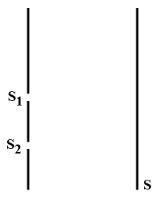
In a Young's double slit experiment, the intensity of light at each slit is $I_0$. Interference pattern is observed along a direction parallel to the line $S_1 S_2$ on screen $S$. The minimum, maximum and the intensity averaged over the entire screen are respectively.
An ammeter reads upto 1 ampere. Its internal resistance is 0.81 ohm. To increase the range to 10 A the value of the required shunt is
Which of the following is not the property of a cathode ray
Assertion : All electric devices shown in the circuit are ideal. The reading of each of ammeter $(a)$ and voltmeter $(V)$ is zero.

Reason : An ideal voltmeter draws almost no current due to very large resistance, and hence $(V)$ and $(a)$ will read zero.