Question
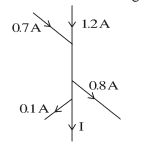
What is the value of I in the given figure?
Image

Answer

According to Kirchhoff's law
$0.7 A+1.2 A=0.1 A+0.8 A+ I$
$\Rightarrow \quad 1.9 A=0.9+ I$
$\Rightarrow \quad I =1.9-0.9$
$\Rightarrow \quad I =1.0 A$ Ans.

Need a full question paper?

Generate a complete, print-ready paper with questions like this in minutes — across 16+ boards, with answer keys.
Start Generating Free

Similar questions

For transistor action, which of the following statements are correct:
  1. Base, emitter and collector regions should have similar size and doping concentrations.
  2. The base region must be very thin and lightly doped.
  3. The emitter junction is forward biased and collector junction is reverse biased.
  4. Both the emitter junction as well as the collector junction are forward biased.
The thermal energy developed in a current-carrying resistor is given by U = i2 Rt and also by U = Vit. Should we say that U is proportional to i2 or i?
The speed of light is 299,792,458m/s.
  1. With respect to the earth.
  2. With respect to the sun.
  3. With respect to a train moving on the earth.
  4. With respect to a spaceship going in outer space.
A steel wire of cross-sectional area 0.5mm2 is held between two fixed supports. If the wire is just taut at 20°C, determine the tension when the temperature falls to 0°C. Coefficient of linear expansion of steel is 1.2 × 10⁻⁵ °C-1 and its Young's modulus is 2.0 × 10¹¹N m-2.
Write expression in vector form for produced magnetic field due to small part of a current carrying conductor in Biot-Savart law.
On a metallic target, when high energy electrons are struck, electromagnetic waves are produced. Name these waves.
A uniform wire of resistance $50\Omega$ is cut into 5 equal parts. These parts are now connected in parallel. What is the value of equivalent resistance of the combination?
Define intensity of magnetisation.
Draw lines of force due to point charges when
(i) $q<0$ and (ii) $q>0 . \quad$
When a body is weighed on an ordinary balance we demand that the arm should be horizontal if the weights on the two pans are equal. Suppose equal weights are put on the two pans, the arm is kept at an angle with the horizontal and released. Is the torque of the two weights about the middle point (point of support) zero? Is the total torque zero? If so, why does the arm rotate and finally become horizontal?